Connected fleet technology streamlines operations, automates bookings, and enables real-time monitoring. Learn features, types, and key benefits.
Connected Fleet Explained: Transforming Fleet Management
Managing a fleet across multiple Canadian provinces can feel like juggling booking systems, maintenance logs, and route schedules all at once. The struggle to connect data from different sources slows decision-making and builds inefficiency. A connected fleet ecosystem gives you real-time visibility, tying every vehicle and system together for smarter, faster operations. This article explains the foundational concepts, solution types, and practical benefits of moving your charter or private fleet from silos to seamless automation.
Table of Contents
Defining Connected Fleet And Core Concepts
Types Of Connected Fleet Solutions
How Connected Fleet Systems Operate
Benefits And Real-World Use Cases
Challenges, Costs, And Common Pitfalls
Key Takeaways
Point | Details |
|---|---|
Importance of Connected Fleets | A connected fleet integrates real-time data across all operational areas, improving decision-making and efficiency. |
Choosing the Right Solution | Select solutions based on operational needs, focusing on integration with existing systems to enhance implementation efficiency. |
Real-World Impact | Operators experience significant cost reductions and operational improvements, showcasing the tangible benefits of connected fleet technology. |
Implementation Challenges | Awareness of integration challenges and user adoption is crucial; addressing these can significantly mitigate risks associated with new technologies. |
Defining Connected Fleet and Core Concepts
A connected fleet is not just a collection of vehicles with GPS trackers. It’s a network of vehicles enriched with real-time data from multiple sources, including OEM backends, telematics systems, and operational data. This convergence creates actionable intelligence your business can act on immediately.
The core concept separates connected fleets from traditional fleet management. You’re not just tracking where your buses and coaches are. You’re capturing engine diagnostics, fuel consumption patterns, driver behavior, maintenance needs, and capacity utilization—all in real-time.
Connected fleets solve a critical problem in charter and private transportation: data lives in silos. Your booking system has one set of information. Your maintenance records sit in another system. Your driver schedules exist in spreadsheets. Connected fleet technology breaks these walls down.
Here’s what a truly connected fleet ecosystem includes:
Vehicle connectivity through telematics and OEM data integration
Analytics platforms that process raw vehicle data into usable insights
Back-office systems linked to operational decision-making
Geospatial and scheduling data that informs route optimization and capacity planning
Financial integration connecting operational metrics to revenue impact
For a Canadian charter operator, this means your reservation system talks to your dispatch system, which talks to your maintenance tracking, which feeds into your financial analytics. When a vehicle is booked at 85% capacity heading to Banff, your system already knows its fuel consumption rate, current maintenance status, and optimal route based on real-time traffic.
A connected fleet transforms isolated data points into a unified operational intelligence system that responds to business conditions in real-time.
The business impact is measurable. You reduce fuel waste through optimized routing. You prevent costly breakdowns by scheduling maintenance before problems occur. You maximize revenue by understanding utilization rates per vehicle, per route, and per season. You improve passenger satisfaction because operations run smoother.
Core concepts matter because they define what success looks like. You’re not implementing “technology for technology’s sake.” You’re building an ecosystem where composable partner solutions manage vehicle data combined with analytics to optimize how your fleet performs against your business goals.
For charter operators managing multiple vehicles across varying routes and seasons, connected fleets solve the fundamental problem: how do you make faster, smarter decisions when your operation runs 24/7 across a province?
Pro tip: Start by identifying your biggest operational pain point—whether that’s maintenance surprises, booking accuracy, or fuel costs—and measure it before implementing connectivity tools, so you can prove the actual impact connected fleet data delivers.
Types of Connected Fleet Solutions
Connected fleet solutions come in distinct categories, each addressing different operational needs. Understanding the types helps you choose the right fit for your charter or private transportation business.
Cloud-based telematics platforms form the backbone of most modern connected fleets. These solutions integrate IoT technology with your vehicle operations, combining hardware sensors, connectivity layers, and software dashboards into a unified system. Cloud-based telematics enables real-time monitoring across your entire fleet without requiring on-premise servers or complex infrastructure.
Within cloud-based telematics, you’ll find several sub-types working together:
Predictive maintenance solutions that flag issues before breakdowns occur
Route optimization engines that reduce fuel consumption and improve schedules
Driver behavior analytics that improve safety and reduce insurance costs
Real-time GPS and capacity tracking that feeds directly into your booking system
Hybrid connectivity systems that work across cellular, satellite, and WiFi networks
Another major category involves composable partner solutions centered on cloud-based architectures. These aren’t monolithic systems. They’re modular platforms where you connect best-of-breed tools—your booking system, dispatch software, maintenance platform, and financial analytics—through cloud-based integration layers.
This modular approach matters for Canadian operators managing growth. You start with core capabilities like automated quoting and real-time dispatch, then add predictive maintenance as your fleet expands, then layer in advanced financial analytics when you need deeper profitability insights.
Operational intelligence platforms sit at the top of the connected fleet stack. These aggregate data from all your other systems—telematics, booking, maintenance, driver logs—and transform raw information into actionable business decisions. Instead of checking five different dashboards, you see: “Your Banff route is 15% below target utilization this month; fuel costs are 8% higher than forecast; Vehicle 7 needs transmission service in 200 miles.”
The best connected fleet solution for your business matches your current pain points, not your competitor’s tech stack.
For charter operators, the most practical approach combines cloud telematics for vehicle intelligence with modular integration for business operations. This gives you real-time visibility into what’s happening on the road while connecting booking data to maintenance schedules to financial reporting.
Pro tip: Start by evaluating solutions that integrate with your existing booking system rather than replacing it; this cuts implementation time by 60% and reduces staff training needs significantly.
Here’s a comparison of core connected fleet solution types and their advantages:
Solution Type | Primary Focus | Key Advantage | Best Fit For |
|---|---|---|---|
Cloud Telematics | Real-time vehicle monitoring | Immediate data access fleetwide | Operators needing rapid rollout |
Composable Platforms | Modular business integration | Easy to add features as needed | Growing fleets with diverse systems |
Operational Intelligence | Centralized analytics | Single dashboard for all data | Decision-makers seeking big-picture insight |
How Connected Fleet Systems Operate
Connected fleet systems work like a nervous system for your entire operation. Every vehicle transmits data constantly, and that information feeds into decision-making systems that adjust your business in real-time.
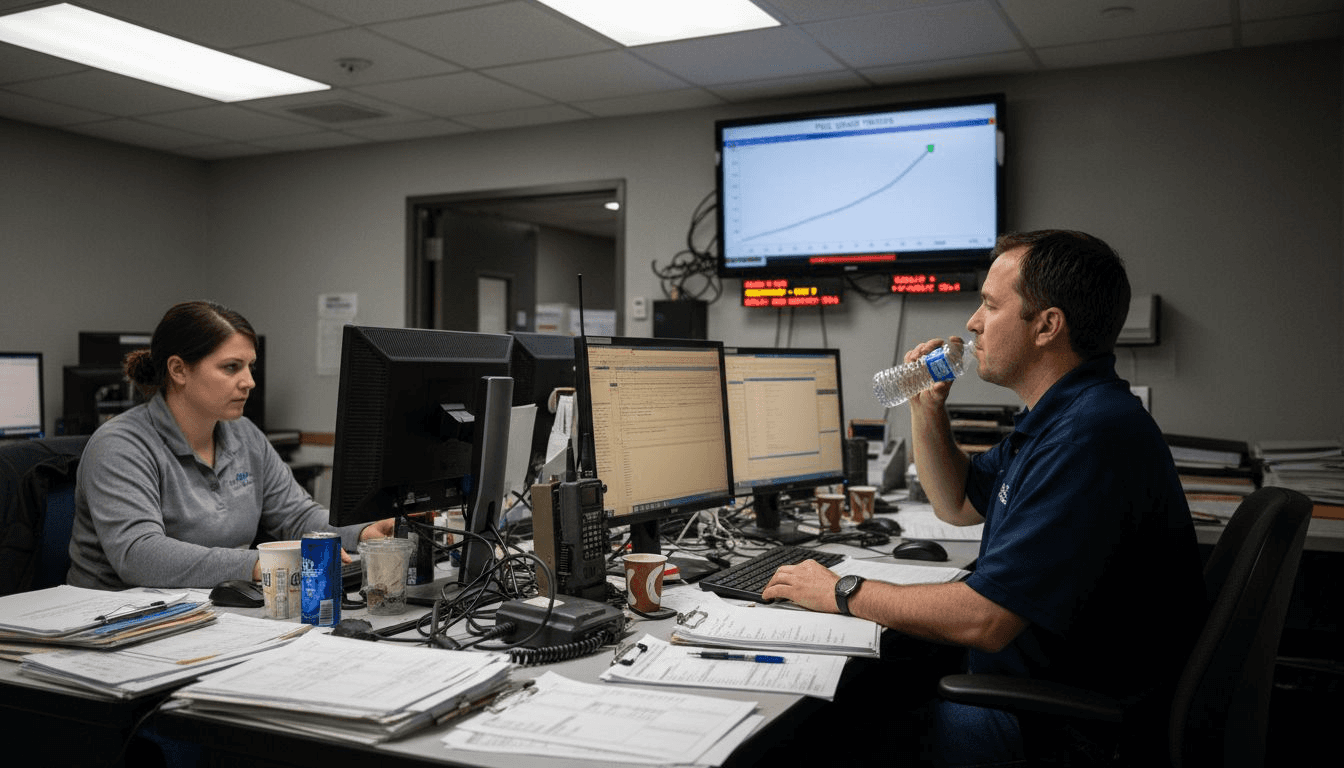
Here’s the basic architecture. IoT devices collect real-time data from sensors embedded in each vehicle—engine diagnostics, GPS location, fuel consumption, door openings, temperature readings. This data flows continuously to cloud servers, not sitting idle on your vehicle until someone plugs in a diagnostic tool.
The data collection happens across multiple layers:
Vehicle sensors capture every operational metric—RPM, fuel level, brake pressure, tire pressure
Connectivity modules transmit data via cellular, satellite, or hybrid networks to ensure coverage even in rural areas
Cloud platforms receive and store this information securely, organizing it by vehicle, route, and time period
Analytics engines process raw data into actionable insights using AI and machine learning
Your dashboard displays what matters for decision-making, not raw telemetry
Once data reaches the cloud, the real intelligence happens. Advanced analytics identify patterns. If Vehicle 3’s fuel consumption suddenly jumps 12%, the system flags potential engine issues before they become expensive repairs. If your driver on the Calgary to Banff route consistently takes a detour that adds 8 minutes, optimization algorithms suggest the faster path.
Predictive maintenance modules use historical data patterns to forecast when components will fail. Your transmission doesn’t just break—the system predicts its failure 200 miles before it happens, allowing scheduled maintenance instead of roadside breakdowns.
Connected systems don’t react to problems; they anticipate them, transforming maintenance from emergency response into planned operations.
Driver performance monitoring tracks safety metrics—harsh braking, excessive speeding, aggressive acceleration. This data feeds into coaching programs and insurance premium negotiations.
For your booking and dispatch operations, connected systems create a continuous feedback loop. When a reservation comes in for the Whistler run, the system checks vehicle availability, fuel levels, maintenance status, and optimal routing—then automatically quotes the price based on real-time capacity and demand data. After the trip completes, actual cost data feeds back into future pricing calculations.
The integration is seamless. Your staff doesn’t manually input information from five different systems. Data flows automatically from telematics to dispatch to maintenance to financial reporting.
Pro tip: Start by identifying which data point would have prevented your most expensive fleet issue in the past year, then verify that connected system captures it before implementation.
Benefits and Real-World Use Cases
Connected fleet technology delivers measurable financial impact. This isn’t theoretical—operators implementing these systems see real money hit the bottom line within months.
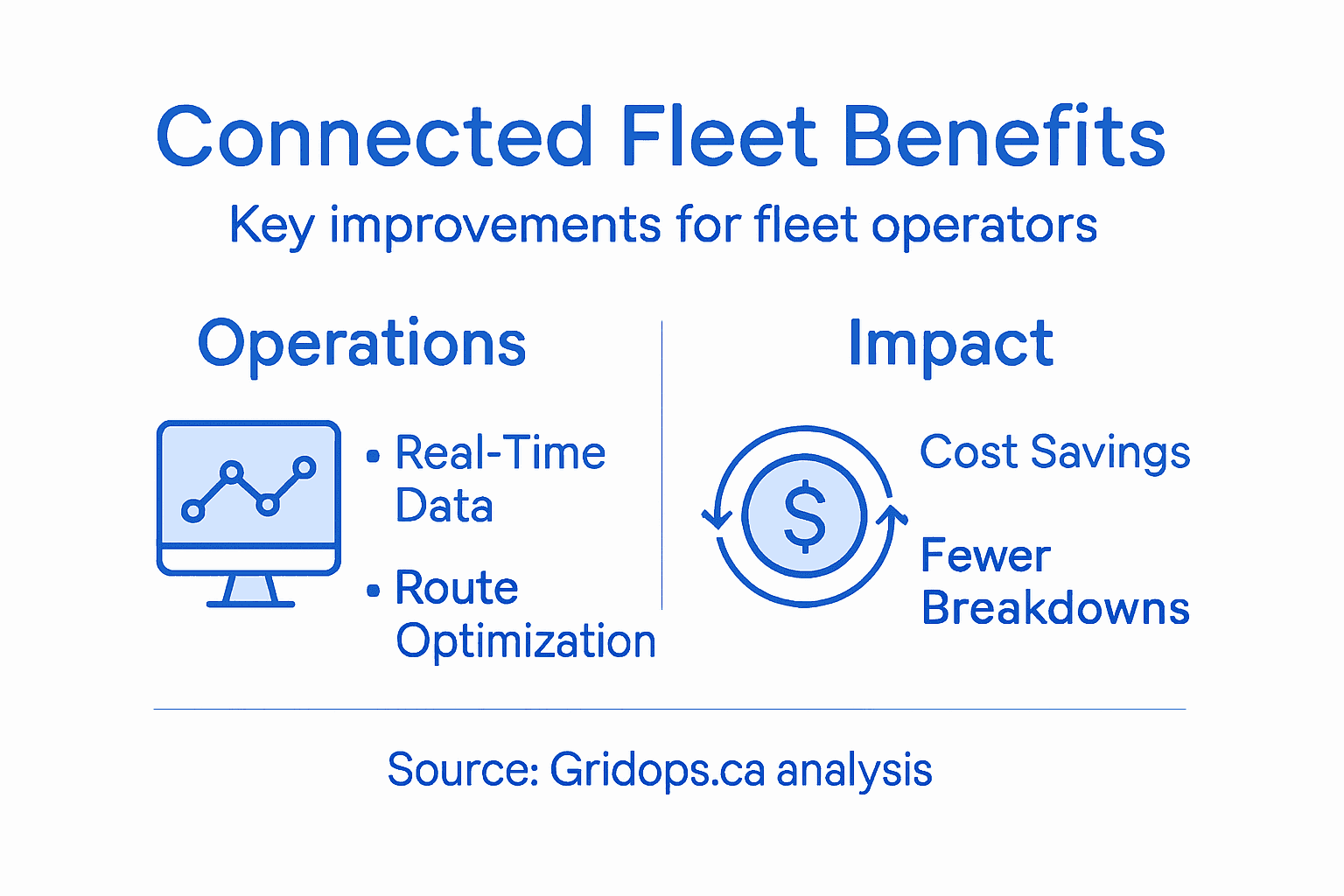
Cost reduction is the most immediate benefit. Predictive maintenance reduces emergency repairs by catching issues before they become catastrophic. Instead of replacing a transmission at $4,500 roadside, you schedule service during off-peak hours at $2,200. Multiply that across a fleet of 20 vehicles over a year, and you’re looking at $40,000 to $60,000 in avoided emergency repair costs.
Fuel optimization creates another revenue stream. Connected systems identify inefficient routes, excessive idling, and aggressive driving patterns that burn fuel unnecessarily. Canadian operators report 8-15% fuel cost reductions after implementing route optimization—that’s $15,000 to $30,000 annually on a mid-sized fleet.
These benefits extend beyond cost control:
Preventive maintenance eliminates unexpected downtime and keeps vehicles earning revenue
Driver safety improvements reduce insurance claims and premium increases
Capacity optimization maximizes bookings per trip and improves revenue per kilometer
Environmental compliance demonstrates sustainability to customers and regulators
Data-driven pricing adjusts quotes based on actual operational costs and demand patterns
Real-world use cases show the practical impact. A Toronto-based charter operator integrated connected fleet systems and discovered 23% of their routes were running at less than 60% capacity. Within three months, they adjusted pricing and marketing for underutilized routes, increasing utilization to 78%. That one insight generated $180,000 in additional annual revenue.
Another case involved a Banff-area private transportation company. Connected systems revealed their most common breakdown pattern: transmission issues on mountain routes. They implemented preventive transmission service every 80,000 kilometers instead of waiting for failure. Result: zero transmission failures in 18 months, up from 4 the previous year.
Fleet management systems synergizing with traffic data improve urban mobility efficiency. A Calgary operator using connected routing reduced delivery times by 12%, improved on-time performance to 97%, and cut emissions by 11%. This translates to happier customers and lower environmental impact.
Connected fleets transform data about what happened into intelligence about what to do next.
The environmental benefit matters increasingly to corporate clients. One British Columbia charter company’s sustainability data—showing 16% emission reductions through optimized routing—became a major selling point to hotel partners seeking eco-conscious transportation.
Security and compliance benefits are less visible but equally valuable. Digital trip sheets eliminate paperwork disputes. Real-time location tracking provides liability protection. Automated maintenance records satisfy insurance auditors.
Pro tip: Start measuring your current performance against industry benchmarks—fuel consumption per kilometer, maintenance cost per mile, asset utilization rate—before implementation, so you can quantify the actual impact your connected fleet system delivers.
Challenges, Costs, and Common Pitfalls
Connected fleet systems promise transformation, but implementation reveals real obstacles. Understanding these challenges before you commit prevents costly missteps.
The integration challenge is brutal. Your vehicles use different manufacturers’ telematics standards. Your booking system runs on one platform. Your maintenance records sit in another. Getting them all talking together requires custom development work. Heterogeneous connectivity standards and interoperability issues create expensive technical debt. One operator spent $45,000 on integration only to discover their legacy dispatch system couldn’t sync with the new telematics data—requiring a complete software overhaul.
Data volume overwhelms unprepared operators. A fleet of 15 buses generates millions of data points monthly. Without proper infrastructure, this becomes noise instead of insight. Staff struggles to interpret dashboards full of metrics nobody understands.
Cost reality differs from marketing promises:
Hardware installation runs $2,500-$4,000 per vehicle for quality telematics hardware
Cloud platform fees typically cost $50-$150 per vehicle monthly
Integration and setup easily exceed $30,000-$60,000 for a mid-sized fleet
Staff training requires weeks of operator education
Ongoing maintenance demands dedicated technical support
The true total cost of ownership over three years often reaches $150,000-$250,000 for a 20-vehicle fleet. Many operators underestimate this commitment.
Cybersecurity risks and data privacy concerns create liability exposure. Vehicle location data can expose driver routes and patterns. Customer payment information requires secure handling. One breach costs far more than system savings. Regular security audits and compliance updates add operational complexity.
User adoption kills more implementations than technology failures. Your drivers resist change. Your dispatchers prefer their old workflow. Your accountant questions the expense. Without buy-in from frontline staff, the system becomes an expensive tool nobody uses effectively.
Systems fail not because they don’t work, but because people don’t use them the way designers intended.
Regulatory compliance varies across Canadian provinces. Alberta, British Columbia, and Ontario have different requirements around driver monitoring and privacy. What works in one province creates problems in another.
Common implementation pitfalls emerge repeatedly. Operators purchase systems without defining what success looks like. They choose software based on price instead of fit. They underestimate staff training needs. They expect immediate ROI without allowing the learning curve.
Vehicle diversity creates hidden friction. A 2024 coach has different telematics capabilities than a 2015 minibus. Mixing generations of vehicles means inconsistent data quality.
Pro tip: Run a 60-day pilot with one vehicle type before fleet-wide implementation; this costs $8,000-$12,000 but prevents $100,000+ mistakes from misaligned expectations or poor vendor fit.
Below is a summary of connected fleet implementation challenges and strategies to address them:
Challenge | Common Impact | Mitigation Strategy |
|---|---|---|
System Integration | High upfront costs, delays | Conduct pilot with key vehicles |
Data Overload | Staff overwhelmed by metrics | Set clear goals for data use |
User Resistance | Poor adoption, wasted investment | Prioritize training and feedback |
Regulatory Variance | Compliance risk by province | Consult local legal experts early |
Unlock the Power of Connected Fleet Management with Gridops.ca
The article highlights the challenge every Canadian charter operator faces: fragmented data scattered across booking, maintenance, and dispatch systems that slows down decision-making and cuts into revenue. If you are struggling with manual processes, outdated spreadsheets, or lack of real-time visibility into your fleet’s performance and bookings, you are not alone. Key goals like predictive maintenance, route optimization, and dynamic pricing all depend on breaking down these data silos to create a truly connected fleet ecosystem.
Gridops.ca understands these pain points and offers a Canadian-built SaaS platform designed exactly to bridge the operational gaps and automate your entire fleet management operation. From instant, automated quotes and real-time dispatch to digital trip sheets and financial analytics, our platform brings together the critical vehicle data and booking information you need to make faster, smarter decisions. Built on enterprise-grade connectivity with integrations for major resellers and tour providers, Gridops.ca empowers you to streamline your workflows, maximize vehicle utilization, and ultimately boost profitability without the headaches of complex integrations or staff resistance.
Experience how true connectivity and intelligent automation will transform your fleet management.
Start optimizing your charter and private transportation operations today with Gridops.ca.

Ready to eliminate manual processes and unlock real-time fleet intelligence? Visit Gridops.ca now to explore how our platform connects your booking, dispatch, maintenance, and financial data seamlessly. Take the first step to a smarter connected fleet with instant quote automation and operational insights tailored for Canadian operators.
Frequently Asked Questions
What is a connected fleet?
A connected fleet is a network of vehicles that are equipped with technology to collect and share real-time data from various sources, including OEM backends and telematics systems. This data enhances operational intelligence, helping businesses make informed decisions.
How do connected fleets improve fuel efficiency?
Connected fleets utilize route optimization and driver behavior analytics to identify inefficient routing and aggressive driving patterns. This targeted approach can result in fuel cost reductions of 8-15%, translating to significant savings across a fleet.
What are the key components of a connected fleet ecosystem?
A connected fleet ecosystem typically includes vehicle connectivity through telematics, analytics platforms for data processing, back-office integration for operational decision-making, and systems for geospatial data and financial management.
How can predictive maintenance benefit fleet operations?
Predictive maintenance identifies potential vehicle issues before they lead to breakdowns, enabling scheduled repairs during off-peak hours. This proactive approach can save significant costs on emergency repairs and minimize unexpected downtime.
Recommended