Fleet management trends for limo operators, focusing on instant quoting and booking, automation, customer experience, and smart tech advantages over Uber.
Fleet Management Trends: Staying Competitive Versus Uber
Managing a limousine fleet in Canada means handling more than just vehicles and drivers—it requires mastery over every moving part, from real-time tracking to instant booking. For fleet managers and owners looking to outpace ride-share competitors, the difference lies in how you harness automation tools that optimize efficiency and customer experience. This guide unpacks the essential elements of modern fleet management and shows how the right technology transforms limo operations into a true competitive advantage.
Table of Contents
Defining Fleet Management For Limo Operators
Instant Quoting And Booking Technology
Automation Tools Driving Operational Efficiency
Enhancing Customer Experience To Rival Uber
Comparing Competitive Advantages With Uber
Key Takeaways
Point | Details |
|---|---|
Effective Fleet Management | Involves real-time tracking, booking management, and driver coordination to enhance operational efficiency and profitability. |
Instant Quoting and Booking | Implementing technology for immediate pricing and booking streamlines customer interactions, making your service more competitive against rideshare services. |
Utilization of Automation | Automating routine processes reduces administrative burdens, allowing fleet operators to focus on customer relations and revenue generation. |
Emphasis on Customer Experience | Providing transparent pricing, professional drivers, and consistent service differentiates you from competitors and builds customer loyalty. |
Defining Fleet Management For Limo Operators
Fleet management is the operational backbone of your limo business. It’s not just about tracking where your cars are or when maintenance is due.
At its core, fleet management for limo operators means controlling every aspect of your vehicle operations—from acquisition and dispatching through driver management, compliance tracking, maintenance scheduling, and real-time customer communication.
The comprehensive approach includes multiple operational layers:
Vehicle operations: Tracking vehicle location, utilization rates, and status in real-time
Booking management: Capturing bookings, quotes, and reservations from multiple channels
Driver coordination: Managing schedules, assignments, and performance metrics
Maintenance oversight: Scheduling service, tracking repairs, and maintaining compliance records
Financial tracking: Monitoring costs, revenue per trip, and profitability
True fleet management means knowing exactly where every vehicle is, who’s driving it, what the customer is paying, and whether you’re making money on each trip.
For limo operators specifically, managing vehicle fleets effectively requires integrating technologies that handle the specialized demands of premium transportation—not just logistics, but customer experience.
Here’s why this matters for your competitive position: Uber doesn’t manage fleets—drivers do. They operate independently with a bare-bones algorithm matching supply to demand.
You manage an actual fleet. That’s harder. But it’s also your advantage.
When you implement instant quoting and instant booking capabilities, you transform fleet management from a backend administrative task into a competitive weapon. Your customers don’t wait for a phone call.
They get a quote in seconds. They book immediately. Your system automatically assigns the right vehicle to the right trip, optimizes routing, and updates your driver in real-time.
That’s what separates professional limo operators from ride-share alternatives.
Modern fleet management also means collecting data that transforms decision-making. Which routes generate the highest margins? Which vehicle types are underutilized? When do customers book most frequently? Which drivers deliver the best customer ratings?
Without integrated fleet management, these insights stay hidden in spreadsheets.
With the right system, they guide every operational decision.
Here’s how modern fleet management functions impact limo businesses:
Function | Business Benefit | Example Outcome |
|---|---|---|
Real-time tracking | Improved operational visibility | Faster response to last-minute changes |
Automated dispatch | Enhanced efficiency | Reduced scheduling errors |
Maintenance alerts | Lower downtime and costs | Fewer breakdowns |
Financial analytics | Increased profitability | Better pricing and expense control |
Pro tip: Start by mapping your actual operational workflow—from initial customer inquiry through vehicle return—then evaluate whether your current system handles each step with minimal manual intervention or delays.
Instant Quoting And Booking Technology
Instant quoting and booking is your direct counter to Uber’s speed advantage. When a customer visits your website, they don’t want to wait for a phone call back.
They want to see a price. Now. And book immediately after.
Modern limo service software delivers exactly that. Real-time availability integration means your system knows which vehicles are free, where they’re located, and what the actual cost will be before the customer even completes the form.
Here’s what happens behind the scenes:
Dynamic pricing calculation: System factors in distance, time of day, vehicle type, and current demand
Real-time availability check: Shows only vehicles that are actually available at the requested time
Automated route optimization: Calculates actual travel time and cost instantly
Instant confirmation: Customer receives booking details immediately with driver assignment
The customer who gets a quote in 30 seconds and books in 60 seconds will never call Uber instead.
Compare this to your old process. Customer calls. You check the schedule. You calculate manually. You call back with a quote. They think about it. Maybe they book tomorrow.
Meanwhile, they already booked with Uber.
Instant quoting eliminates every friction point in that sequence. No waiting. No callbacks. No uncertainty about availability.
The technology also prevents double-bookings automatically. Once a vehicle is assigned to a booking, your system removes that time slot from availability across all channels—your website, phone bookings, third-party platforms.
Your drivers see real-time assignments in their app. They know exactly where to be, when to arrive, and what the trip includes.

Payment processing happens seamlessly too. Customers enter payment details once during booking. No cash exchanges. No disputes. No reconciliation headaches.
This matters because Uber trains customers to expect frictionless transactions. If your booking process requires three steps to what Uber does in one step, you lose the sale.
Instant quoting and booking technology levels that playing field. It says to your customers: we’re just as fast, but we’re actually professional.
The data collected from these instant transactions also transforms your business. You see exactly when customers want to book, which routes generate the highest margins, and which vehicle types are most profitable.
That intelligence guides pricing, vehicle acquisition, and marketing decisions.
Pro tip: Ensure your quoting system displays realistic pickup times based on actual vehicle locations and traffic conditions, not generic estimates—precision builds customer trust and reduces cancellations.
Automation Tools Driving Operational Efficiency
Automation tools eliminate the manual work that bleeds money from your operation. Without them, fleet managers spend hours on tasks that a system could complete in seconds.
Your dispatchers manually assign vehicles. Your maintenance team tracks service dates in spreadsheets. Your finance team reconciles trip data by hand.
Each manual step costs time and introduces errors.
Modern automation handles all of this. Real-time vehicle tracking and predictive maintenance reduces downtime by identifying problems before they strand a vehicle. Route optimization algorithms calculate the fastest path automatically, saving fuel and improving on-time performance.
Here’s what automation actually delivers:
Real-time dispatch assignment: System automatically sends the nearest available vehicle to each booking
Predictive maintenance alerts: Tracks vehicle health and schedules service before breakdowns occur
Driver behavior monitoring: Records safety metrics, fuel efficiency, and compliance data automatically
Financial reconciliation: Matches payments to trips, calculates margins, and flags discrepancies instantly
Route optimization: Calculates fuel-efficient paths based on traffic, vehicle type, and delivery sequence
A vehicle sitting in the yard waiting for maintenance is a liability. Automation prevents that by predicting problems weeks in advance.
Think about what happens when a driver calls in with a breakdown. Without automation, your dispatcher scrambles. They check schedules manually. They reassign trips. They contact customers.
With automation, the system has already rerouted the affected trips to the next available vehicle, notified the customer of a vehicle upgrade, and alerted maintenance to the problem.
That’s the difference between reactive management and proactive operations.
Automation also transforms how you analyze profitability. You see exactly which routes generate the highest margins, which vehicle types are underutilized, and where costs are creeping up.
That intelligence guides every decision—from pricing to fleet composition to driver scheduling.
The competitive advantage is simple: less time on administration means more time on revenue-generating activities and customer relationships.
Uber doesn’t win because their technology is magical. They win because they eliminated the administrative friction that traditional limo operators still battle.
Automation tools close that gap. They move your operation from spreadsheets and phone calls to real-time, data-driven management.
Pro tip: Start by automating your highest-volume, most time-consuming process first—usually dispatch or maintenance scheduling—then expand automation across other areas as your team adapts.
Enhancing Customer Experience To Rival Uber
Customer experience is where limo operators actually have an advantage. You’re not a faceless algorithm matching anonymous drivers to anonymous riders.
You’re a professional service provider. Act like it.
Uber’s strength is convenience. Their weakness is inconsistency. Drivers vary wildly. Vehicle conditions range from immaculate to questionable. Communication is minimal until pickup.
You can dominate this space.
Start with what customers see first: your booking interface. Real-time updates on ride status build trust and reduce anxiety. Customers want to know exactly when their car arrives, who’s driving it, and what the experience will be.
Here’s what separates premium from commodity:
Transparent pricing: Show the exact cost before booking, no surprise surges
Vehicle selection: Let customers choose between Black Car, SUV, or coach seating
Driver profiles: Display driver photo, rating, experience, and vehicle details
Real-time tracking: Send live location updates and estimated arrival times
Direct communication: Enable phone or chat contact with the driver before pickup
Confirmation details: Email and SMS confirmation with all trip information
Customers who know their driver’s name and see their photo arrive feeling like VIPs. That’s not coincidence. That’s intentional design.
Uber treats every ride like a commodity. You treat each customer like a relationship.
That difference shows. When a customer books a limo for an airport run or special event, they’re already paying a premium. They expect premium service.
If your booking system looks cheap, your service feels cheap.
Invest in a professional interface that reflects your brand. Make instant quoting visually appealing. Show vehicle photos. Display driver information. Provide multiple contact options.
The psychological impact is enormous. A customer who feels informed and cared for rates you higher, books again, and recommends you to friends.
After booking, continue the experience. Send reminders 24 hours before. Confirm pickup 2 hours prior. Update them if traffic impacts arrival time.
These touches cost nothing. They feel like everything.
Driver professionalism matters too. Your drivers aren’t gig workers supplementing income. They’re professional chauffeurs representing your brand.
They should have training, accountability, and pride in what they do.
That translates directly to customer perception. Professional drivers deliver professional experiences. Professional experiences command premium pricing.
Uber competes on price and convenience. You compete on experience and trust.
Pro tip: Ask customers for feedback after every trip and respond personally to both positive and negative reviews—customers who feel heard become loyal advocates.
Comparing Competitive Advantages With Uber
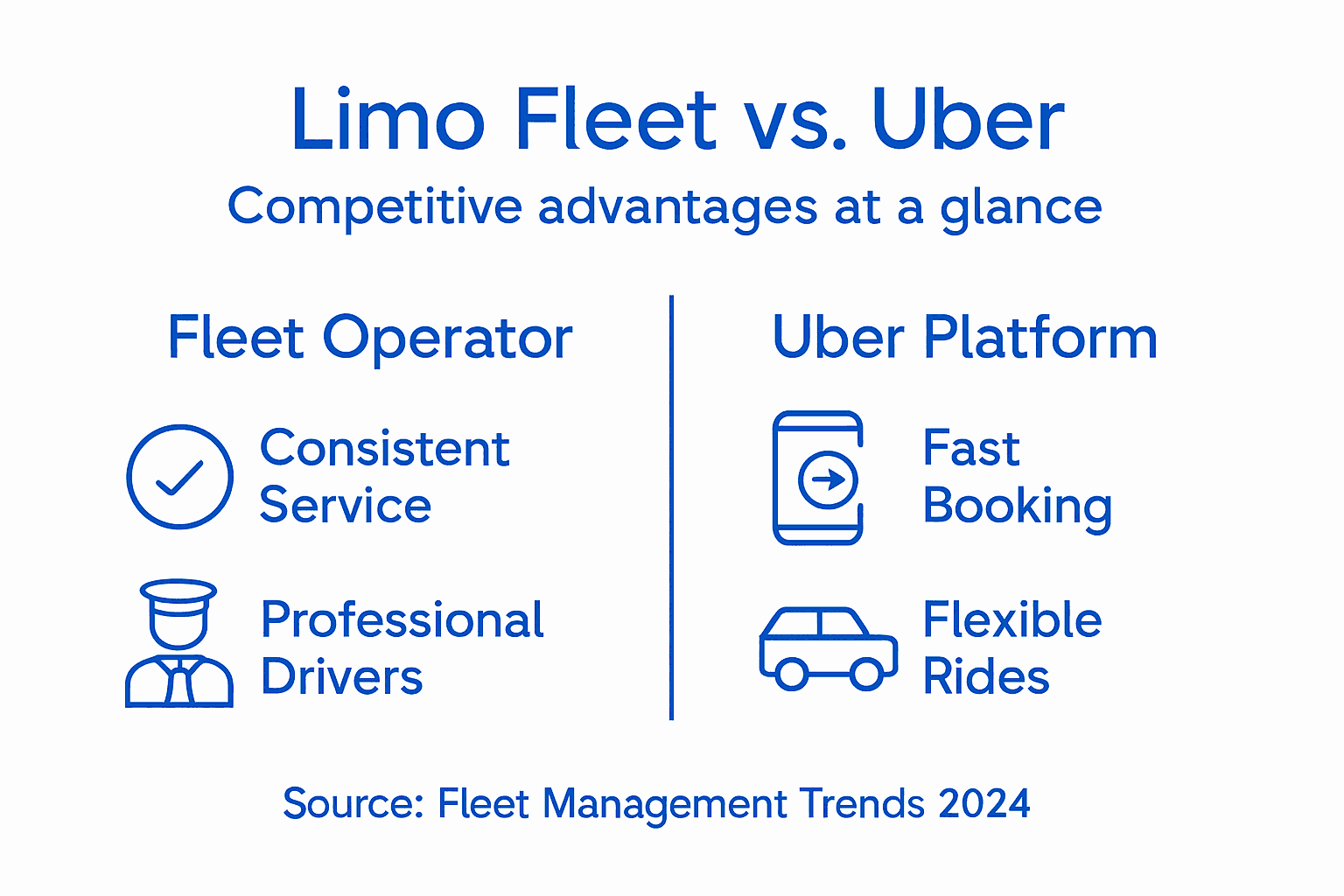
You don’t beat Uber by copying Uber. You beat Uber by leveraging what Uber deliberately abandoned: accountability, consistency, and professional standards.
Uber’s competitive model relies on speed and volume. They match supply to demand algorithmically. Driver quality varies. Vehicle conditions are unpredictable. Customer service is minimal.
But that model has hard limits.
Uber dominates in one-off rides. They’re terrible at corporate contracts, event transportation, and premium services where reliability matters.
That’s where you win.
Uber’s competitive advantages include global brand recognition and pricing strategies, but traditional fleet operators offer something they can’t: controlled, predictable service quality.
Here’s where your advantages lie:
Consistency: Your vehicles are uniformly maintained and branded consistently
Accountability: Customers know exactly who’s driving and can rate that specific driver
Reliability: You guarantee vehicle availability and professional standards
Corporate integration: You handle contracts, invoicing, and account management
Specialization: You offer premium vehicles, wheelchair-accessible options, and large groups
Service quality: Professional drivers with training, background checks, and accountability
Uber scales through chaos. You win through control.
Uber’s model breaks down at scale with premium services. Managing 50,000 drivers across a city means quality control is impossible.
You manage 20 vehicles with professional drivers you’ve trained personally. Your consistency is your competitive moat.
Corporate clients specifically avoid Uber because driver quality is unpredictable. One bad ride ruins a client relationship worth thousands of dollars.
But they’ll contract with you if you guarantee professionalism.
Pricing is another advantage. Uber’s surge pricing frustrates customers during peak demand. You can offer transparent, guaranteed pricing because you control your fleet.
A customer who books a limo for an important event knows the exact cost, knows the driver’s name, and knows what to expect.
That certainty is worth a premium.
Comparing premium limo fleet operators to Uber in key areas:
Area | Limo Fleet Operator | Uber |
|---|---|---|
Service Consistency | Uniform vehicles, trained staff | Varies by driver and car |
Pricing Structure | Transparent, fixed rates | Dynamic, surge-pricing |
Customer Support | Dedicated, personalized help | Minimal, app-based support |
Corporate Suitability | Contract, invoicing, reliability | Rare, lacks tailored solutions |
Technology is not Uber’s exclusive domain. When you implement instant quoting and booking with professional-grade reservation tracking, you’re offering the same seamless experience with better reliability.
The difference is your vehicle will actually show up on time, driven by a professional who cares about the experience.
Uber’s weakness is also your opportunity: scale requires sacrificing quality. You can offer quality at meaningful scale.
Pro tip: Focus your marketing on reliability and professionalism rather than competing on price—corporate clients and high-value consumers will always choose guaranteed quality over commodity pricing.
Take Control of Your Fleet Management to Outperform Uber
The article highlights the critical challenges limo operators face when competing against Uber: managing consistent service quality, enabling instant quoting and booking, and automating complex fleet operations to boost efficiency and profitability. Manual processes like spreadsheets and phone bookings create costly delays and errors that put traditional limo services at a disadvantage against Uber’s frictionless model. Your goal is clear: adopt intelligent automation, dynamic pricing, and real-time dispatch tools to transform your fleet into a premium, reliable, and customer-friendly service.
Gridops.ca offers a Canadian-designed platform built precisely for these needs. Our SaaS solution automates instant quoting, reservation tracking, financial analytics, and maintenance scheduling—all integrated seamlessly to eliminate manual bottlenecks. With enterprise-grade connectivity expanding your sales channels, you gain not only operational control but also a strategic advantage that turns challenges into profit opportunities.
Ready to modernize your limo fleet management and deliver a superior customer experience that stands out from Uber?

Explore how easy it is to streamline bookings, dispatch, and fleet logistics with Gridops.ca. Visit us now and start transforming your fleet into a competitive powerhouse with professional automation and intelligent tools designed for transportation operators like you.
Frequently Asked Questions
What is fleet management for limo operators?
Fleet management for limo operators involves overseeing all aspects of vehicle operations, including vehicle tracking, driver management, compliance, maintenance scheduling, and customer interactions.
How can instant quoting and booking technology improve my limo business?
Instant quoting and booking technology streamlines the customer experience by providing quick price estimates and allowing immediate bookings, reducing the likelihood of customers opting for competing services like Uber.
What benefits do automation tools offer in fleet management?
Automation tools enhance operational efficiency by reducing manual tasks, enabling real-time dispatch, and minimizing errors, ultimately saving time and lowering costs.
How can improving customer experience help limo operators compete with Uber?
By offering a superior customer experience, such as consistent service, professional drivers, and transparent pricing, limo operators can establish strong customer relationships and gain an advantage over rideshare services like Uber.
Recommended