Discover how automated reservation systems process bookings, manage overbooking, optimize pricing, and boost profitability for Canadian charter operators in 2026.
How automated reservation works: streamline bookings 2026
Charter operators often hesitate to adopt automated reservation systems, fearing complexity or loss of personal control over bookings. Yet these systems are designed to simplify workflows, not complicate them. Automation captures bookings from multiple channels, checks vehicle availability instantly, and confirms reservations without manual intervention. This guide explains exactly how automated reservation systems process bookings, manage overbooking risks, optimize pricing dynamically, and ultimately boost profitability for Canadian charter and private transportation operators seeking efficient, scalable solutions.
Table of Contents
How Automated Reservation Systems Process Bookings
Handling Overbooking And Pricing Dynamically With Data-Driven Strategies
Comparing Manual And Automated Reservation Workflows In Charter Transport
Implementing Automated Reservation Solutions For Charter Operators
Explore GridOps Automation For Charter Reservations
Frequently Asked Questions
Key takeaways
Point | Details |
|---|---|
Reduced booking errors | Automated systems minimize manual entry mistakes and speed up customer confirmations. |
Optimized fleet utilization | Probabilistic overbooking and dynamic pricing maximize vehicle use without creating disputes. |
Real-time data integration | Flight delay tracking and instant availability checks prevent scheduling conflicts. |
Increased profitability | Automation boosts revenue by capturing more bookings and reducing operational costs. |
Competitive advantage | Operators using automation respond faster and operate more efficiently than manual competitors. |
How automated reservation systems process bookings
Automated reservation systems transform how charter operators handle booking requests by eliminating manual steps and accelerating customer responses. When a booking request arrives via your website, phone system, or partner portal, the software instantly checks real-time vehicle availability across your entire fleet. This immediate availability check prevents double bookings and ensures customers receive accurate quotes within seconds, not hours.
Dynamic inventory management sits at the core of automated systems. As each reservation is confirmed, the system updates fleet status continuously, reflecting vehicle assignments, maintenance schedules, and driver availability. This real-time synchronization means every booking decision uses current data, reducing conflicts and maximizing utilization. Automated systems reduce lost bookings by providing instant quotes and confirmations, capturing sales that would otherwise slip away during manual processing delays.
The workflow follows a clear sequence:
Customer submits booking request through any connected channel
System queries current fleet availability and pricing rules
Software calculates optimal vehicle assignment and quote
Customer receives immediate confirmation or alternative options
Reservation data flows automatically to dispatch and billing systems
Cancellations and modifications are handled with equal efficiency. When a customer requests a change, the system recalculates availability, adjusts pricing if needed, and updates all connected modules without requiring staff to manually coordinate across spreadsheets or phone calls. This seamless handling of changes reduces administrative burden and improves customer satisfaction through faster, more reliable service.
Pro Tip: Configure your automated system to send confirmation emails with trip details immediately upon booking completion. This instant communication reassures customers and reduces follow-up inquiries, freeing your team to focus on service delivery rather than status updates.
Understanding the basic workflow sets up a discussion on how advanced techniques like overbooking and dynamic pricing optimize fleet utilization.
Handling overbooking and pricing dynamically with data-driven strategies
Probabilistic overbooking represents one of the most sophisticated capabilities of modern reservation systems, yet it operates on straightforward principles. The system analyzes historical no-show data to calculate the likelihood that confirmed reservations will actually materialize. Using this statistical foundation, overbooking uses historical data with thresholds and fallback options to avoid conflicts. Operators set risk thresholds based on their comfort level and operational capacity, allowing the system to accept a calculated number of additional bookings beyond strict vehicle availability.
Fallback procedures form the safety net that makes probabilistic overbooking viable. When actual demand exceeds available vehicles, automated systems trigger predefined responses:
Offer customers a free upgrade to a larger or premium vehicle
Coordinate with partner operators to fulfill the booking through your network
Propose alternative pickup times that align with fleet availability
Provide compensation or discounts to maintain customer satisfaction
These automated fallbacks execute faster than manual coordination, often resolving potential conflicts before customers even notice a problem. The key is setting conservative initial thresholds and gradually adjusting based on actual performance data.
Dynamic pricing operates alongside overbooking to maximize revenue opportunities. Dynamic pricing adjusts for demand using strategy patterns that respond automatically to fluctuations and seasonal trends. The system monitors booking velocity, competitor pricing, special events, and historical patterns to adjust rates in real time. During peak demand periods like holidays or major conferences, prices increase incrementally to balance supply and demand. Conversely, during slower periods, strategic discounts encourage bookings that would otherwise go unfilled.
Pricing Strategy | Application | Revenue Impact |
|---|---|---|
Demand-based | Increases rates during high-demand windows | 15-25% revenue lift |
Time-based | Premium pricing for last-minute bookings | 10-20% margin improvement |
Seasonal | Adjusts for predictable annual patterns | Smooths revenue across seasons |
Competitive | Matches or beats local operator rates | Maintains market share |
Buffers and blackout periods prevent peak-time conflicts by building safety margins into the scheduling system. During known high-demand windows like airport rush hours or convention center events, the system automatically extends turnaround times between trips or blocks certain booking combinations. This conservative approach during critical periods protects service quality and prevents the operational chaos that damages reputation.
Flight delay data integration enables timely schedule adjustments without manual monitoring. When your system connects to real-time flight tracking APIs, it automatically detects delays affecting airport transfers and adjusts pickup times accordingly. This proactive adjustment reduces wasted driver time, prevents customer frustration, and demonstrates operational sophistication that builds trust.
Operators who implement data-driven overbooking and dynamic pricing report 20-30% improvements in fleet utilization within the first six months, translating directly to bottom-line profitability gains without adding vehicles or staff.
Pro Tip: Start with conservative overbooking thresholds of 5-10% and monitor actual no-show rates for three months before adjusting. This cautious approach builds confidence in the system while protecting against early conflicts that could undermine staff buy-in.
With these optimization techniques explained, next we contrast automation with manual systems to highlight competitive advantages.
Comparing manual and automated reservation workflows in charter transport
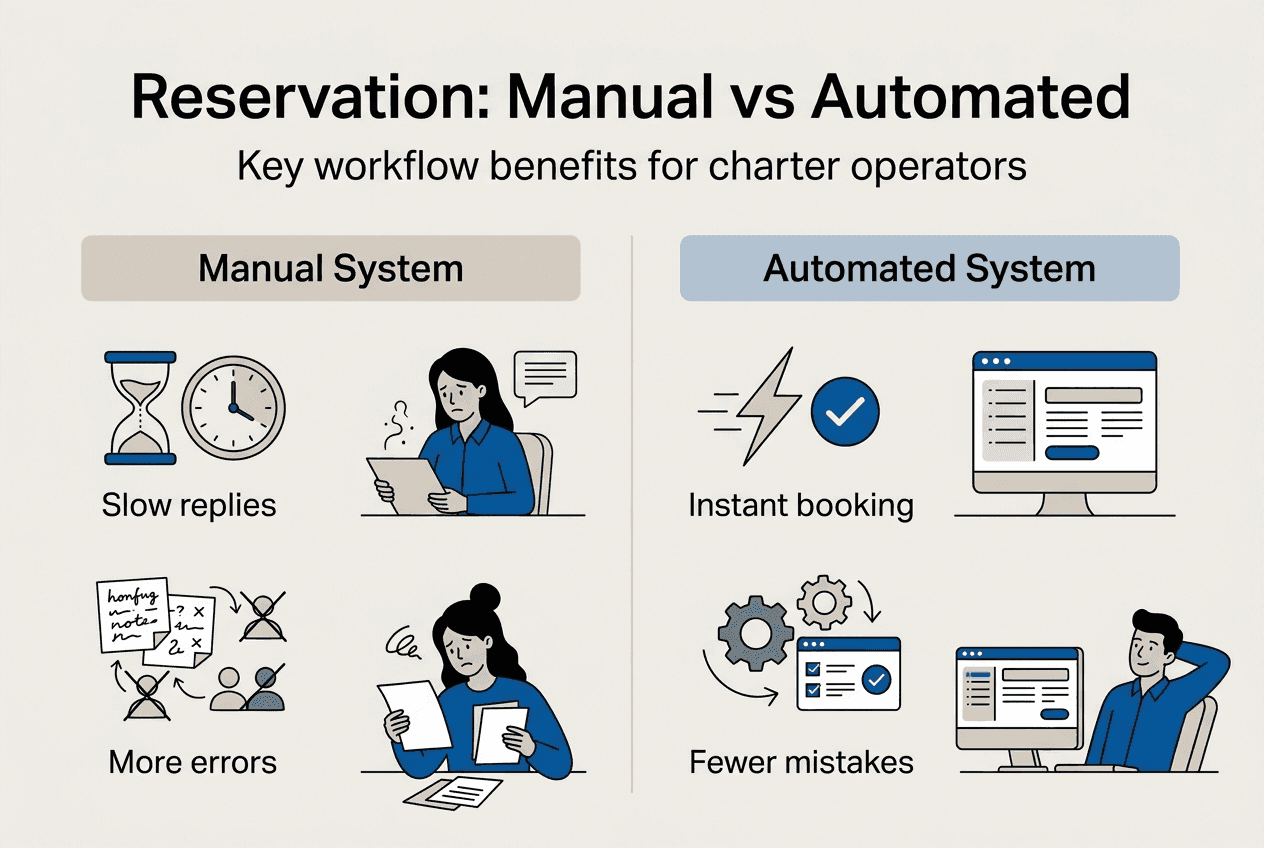
The operational differences between manual and automated reservation systems create clear competitive advantages for operators who embrace technology. Manual booking processes risk lost sales and operational inefficiencies compared to automated systems that respond instantly and accurately. When a potential customer calls a manually operated charter company, they often wait on hold, leave voicemails, or receive callbacks hours later. By that time, many have already booked with faster competitors.
Automated systems enable higher booking capture rates by eliminating response delays. A customer visiting your website receives an instant quote and can complete their reservation immediately, even outside business hours. This 24/7 availability captures bookings that manual systems miss entirely. The accuracy advantage is equally significant. Manual processes involve transcribing customer information, checking availability across multiple sources, calculating pricing, and coordinating with dispatch. Each step introduces error opportunities that automated systems eliminate through direct data integration.

Process Aspect | Manual System | Automated System |
|---|---|---|
Average response time | 2-24 hours | Instant to 2 minutes |
Booking error rate | 8-15% | Under 2% |
After-hours availability | None | Full capability |
Staff hours per booking | 15-20 minutes | 2-3 minutes |
Overbooking management | Reactive, error-prone | Proactive, data-driven |
Probabilistic optimization techniques reduce risk and improve fleet use in ways manual systems cannot match. Academic models show automated optimization outperforms manual holdouts under uncertainty. Human operators typically apply simple rules like never booking beyond 100% capacity, leaving revenue on the table. Automated systems use sophisticated algorithms to find the optimal balance between maximizing utilization and minimizing conflict risk, adjusting continuously as new data arrives.
The competitive profitability advantages extend beyond immediate booking efficiency:
Reduced labor costs through automated quote generation and confirmation
Higher revenue per vehicle through optimized utilization and dynamic pricing
Improved customer satisfaction from faster, more reliable service
Better cash flow management through integrated payment processing
Enhanced decision-making supported by real-time analytics and reporting
Operators using automation gain market share by offering superior customer experiences while maintaining lower operational costs. This combination proves difficult for manual competitors to match without adopting similar technology. The gap widens over time as automated systems accumulate data and refine their optimization algorithms, while manual systems remain static.
Industry analysis shows charter operators who transition from manual to automated reservation systems typically see 40-60% reductions in booking-related administrative time within the first quarter, allowing staff redeployment to higher-value activities like customer relationship management and service quality improvement.
The benefits of advanced booking systems compound as operators scale, making automation essential for growth-oriented businesses in the competitive Canadian charter transport market.
Having understood the operational differences, we now turn to practical steps for operators to successfully implement automated reservations.
Implementing automated reservation solutions for charter operators
Successful implementation begins with assessing your specific business needs and operational constraints. Not all charter operators require the same level of automation sophistication. A small operator with a handful of vehicles and primarily local service needs different capabilities than a regional operator managing diverse vehicle types and complex routing. Start by documenting your current pain points: Where do bookings fall through? What processes consume excessive staff time? Which customer complaints recur most frequently?
Choosing suitable charter booking software requires evaluating several critical factors:
Integration capabilities with your existing dispatch and accounting systems
Scalability to accommodate fleet growth without platform migration
User interface simplicity to minimize training requirements
Support for Canadian payment processing and tax regulations
Vendor reputation and long-term viability in the transportation technology market
API integration for real-time data forms the technical foundation of effective automation. Integrating flight APIs and buffers helps manage edge cases effectively by connecting your reservation system to external data sources. Flight tracking APIs provide delay notifications for airport transfers. Weather APIs help anticipate service disruptions. Partner network APIs enable seamless booking coordination across multiple operators. Each integration reduces manual monitoring and enables proactive rather than reactive management.
Setting overbooking thresholds using historical data requires a methodical approach:
Collect at least three months of no-show and cancellation data before enabling overbooking
Calculate no-show rates separately for different booking types (corporate, tourist, event)
Start with conservative thresholds 50% below calculated optimal levels
Monitor actual overbooking outcomes weekly during the first month
Adjust thresholds gradually in 2-3% increments based on performance data
Buffer times and blackout periods during peak seasons protect service quality when demand surges. Configure your system to add 15-30 minute buffers between airport runs during morning and evening rush hours. Implement blackout periods that prevent certain booking combinations during major events when traffic congestion or venue access restrictions create elevated risk. These protective measures cost some theoretical utilization but prevent service failures that damage reputation far more than missed bookings.
Staff training on the system determines whether automation delivers its potential benefits or creates frustration. Focus training on exception handling rather than routine operations, since the system manages standard bookings automatically. Teach your team how to override automated decisions when customer circumstances warrant, how to interpret system recommendations, and how to communicate with customers when automated fallbacks activate. This human expertise layered over automated efficiency creates the optimal operational model.
Pro Tip: Run your automated system in parallel with manual processes for two weeks before fully transitioning. This overlap period builds staff confidence, reveals integration issues before they affect customers, and provides comparison data proving the system’s value to skeptical team members.
The strategies to automate bookings you implement should align with your growth objectives and customer service standards, creating a foundation for sustainable competitive advantage.
After outlining implementation steps, the article will offer a brief promotional note on software solutions that support these features.
Explore GridOps automation for charter reservations
GridOps delivers exactly the automation capabilities Canadian charter operators need to compete effectively in 2026. Our platform provides real-time booking and dynamic pricing modules that work together seamlessly, capturing more reservations while optimizing revenue per trip. The system features probabilistic overbooking tools and integrated flight APIs that handle complex scheduling scenarios automatically, reducing conflicts and improving fleet utilization.

Designed specifically for charter and private transportation operators across Canada, GridOps eliminates the spreadsheet chaos and phone tag that plague manual booking systems. The user-friendly interface reduces training time and errors, getting your team productive within days rather than weeks. Our flexible pricing plans suit operators of all sizes, from small local services to regional fleets, with transparent costs that scale with your business. Discover how GridOps transforms reservation management into a competitive advantage.
After this introduction to helpful technology options, the article will close with an FAQ addressing common practical questions.
Frequently asked questions
How does automated reservation prevent overbooking conflicts?
Automated systems use historical no-show data combined with set risk thresholds to minimize overbooking conflicts while maximizing fleet utilization. The software calculates optimal booking levels based on statistical analysis rather than guesswork, then triggers fallback procedures automatically when conflicts arise. These fallbacks include vehicle upgrades, partner operator coordination, or alternative timing that resolves issues before customers experience service failures. Real-time adjustments for flight delays or cancellations further reduce conflicts by proactively updating schedules as conditions change, demonstrating the benefits of automated reservations in managing complex scenarios.
What integration is needed for dynamic pricing in reservation systems?
Dynamic pricing requires integration with historical booking data and demand forecasting modules that analyze patterns across time periods, customer segments, and market conditions. The system must connect with inventory management to understand real-time vehicle availability and with scheduling modules to identify high-demand windows. Many operators also integrate competitor pricing feeds and local event calendars to inform pricing decisions. These data sources feed algorithms that adjust rates automatically, balancing revenue optimization with booking conversion rates to maximize profitability without deterring customers.
How do automated systems improve operational efficiency for charter operators?
Automation cuts booking errors by eliminating manual data entry and transcription mistakes that plague phone and email-based systems. Faster customer confirmations increase sales by capturing bookings that would otherwise go to competitors during response delays. Fleet utilization improves through data-driven scheduling that optimizes vehicle assignments and identifies underused capacity. The reservation tracking workflow becomes streamlined as information flows automatically between booking, dispatch, billing, and reporting systems, reducing administrative overhead and freeing staff for customer-focused activities that drive satisfaction and repeat business.
What are common risks when switching to automated reservation systems?
Improperly set overbooking thresholds can cause conflicts if operators enable aggressive settings without adequate historical data or fallback procedures. Lack of staff training leads to operational errors when team members don’t understand how to handle exceptions or override automated decisions appropriately. Integration gaps may cause data inconsistencies if the new system doesn’t connect properly with existing dispatch, accounting, or partner platforms. Successful operators mitigate these risks by implementing gradually, training thoroughly, and choosing proven types of reservation systems with strong vendor support and integration capabilities.
Recommended