Why use real-time booking for limo operators: learn how instant online reservations boost efficiency, maximize revenue, and improve client satisfaction.
Why Use Real-Time Booking for Limo Operators
Manual booking methods can turn every ride request into a drawn-out task, slowing down service and leaving customers waiting. For Canadian limo operators, the demand for instant booking confirmation and live vehicle tracking is growing as passengers expect faster, more reliable service. Real-time booking technology eliminates delays by automatically matching each request with available vehicles and confirming reservations on the spot, allowing you to increase fleet efficiency and deliver the immediate experience today’s riders want.
Table of Contents
Defining Real-Time Booking For Limo Services
How Real-Time Booking Systems Operate
Key Benefits For Modern Limo Operators
Comparing Manual And Automated Booking Methods
Increasing Revenue And Improving Client Experience
Key Takeaways
Point | Details |
|---|---|
Real-Time Booking Enhances Efficiency | Automating booking processes reduces response time and errors, maximizing operational efficiency for limo services. |
Instant Confirmation Increases Customer Satisfaction | Immediate booking confirmation builds trust, leading to higher customer retention rates. |
Dynamic Pricing Maximizes Revenue | Automated pricing adjustments allow for capturing more revenue during peak demand times without manual intervention. |
Live Tracking Improves Client Experience | Providing real-time vehicle tracking reduces client wait anxiety, encouraging repeat business. |
Defining Real-Time Booking for Limo Services
Real-time booking for limo services means your customers can reserve a vehicle instantly, receive immediate confirmation, and see their assignment happen on the spot. This isn’t a delayed process where requests sit in a queue or wait for manual processing. It happens now.
At its core, real-time booking uses dynamic resource allocation to match passenger requests with available vehicles the moment a request comes in. Your system automatically coordinates schedules, calculates pricing, and assigns the right car from your fleet without human intervention.
Here’s what makes real-time booking different from traditional phone or email bookings:
Instant confirmation: Customers get a booking confirmation immediately after submitting their request
Live vehicle tracking: Passengers see exact pickup times and driver location updates in real time
Automatic pricing calculation: Rates adjust dynamically based on demand, distance, and vehicle availability
Seamless fleet coordination: Your dispatch system knows which vehicles are available before customers even press submit
No manual data entry: Booking information flows directly into your operational system without staff re-entering details
For limo operators specifically, real-time booking eliminates the gap between customer request and vehicle assignment. Traditional systems require someone to check availability, call the customer back, confirm details, and manually enter everything into dispatch software. Real-time booking collapses that entire workflow into seconds.
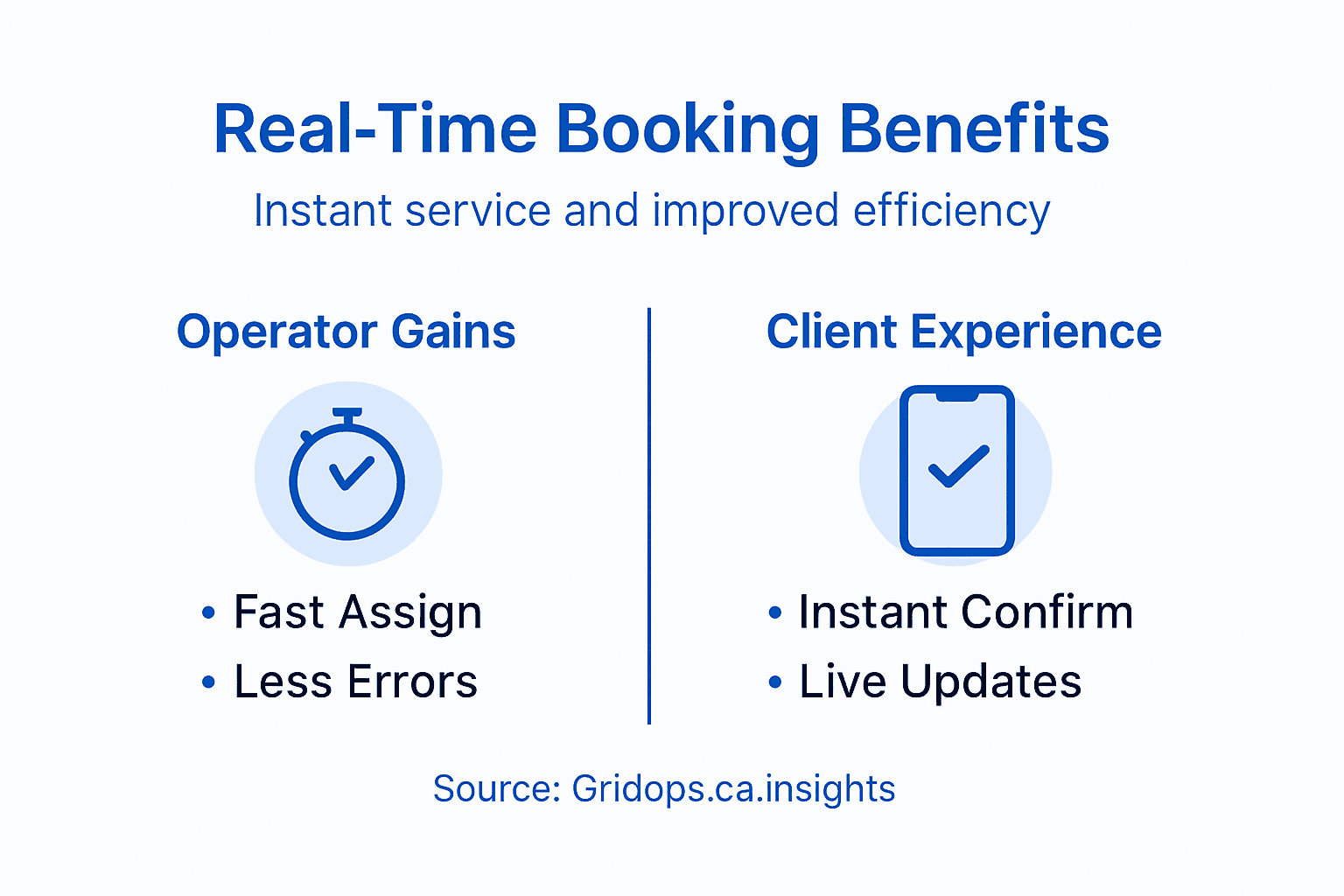
Think of it this way: dynamic matching of passenger requests with drivers happens automatically, accounting for your current capacity and routes. Your customers don’t wait for a callback. Your staff doesn’t juggle multiple spreadsheets or sticky notes.
The system continuously updates based on real operational conditions. If a car breaks down, the system reroutes requests to other vehicles instantly. If demand spikes, pricing adjusts automatically to manage load. Your fleet operates as a coordinated unit, not isolated vehicles.
Pro tip: When evaluating booking solutions, test whether the system provides actual real-time updates to customers during their trip—not just confirmation at booking. Some platforms claim “real-time” but only send notifications at fixed intervals, leaving customers without true live information.
How Real-Time Booking Systems Operate
Real-time booking systems work by constantly monitoring your fleet’s availability and instantly processing customer requests against live data. When a customer submits a booking, the system doesn’t queue the request or wait for staff approval. It validates the request, checks vehicle availability, and confirms the booking in real time.
Here’s the core mechanism: dynamic capacity validation across simultaneous requests ensures every booking slot is accurately assigned only once. If two customers request the same vehicle at the same time, the system handles both requests concurrently and assigns the vehicle to whoever booked first. No double-bookings. No conflicts.
The system maintains a constantly updated database of your fleet status:
Vehicle location and availability: Every car’s status updates in real time as drivers move and complete trips
Route optimization: The system calculates the most efficient pickup and drop-off routes instantly
Pricing calculations: Fares adjust based on current demand, distance, and vehicle type
Customer communication: Automated messages flow to passengers with confirmation, driver details, and live updates
Inventory management: Available time slots disappear from the system immediately after booking
When a booking comes in, messages transmit interactively between your system and the customer’s device. This interactive transmission ensures both sides have identical, up-to-the-second information. Your dispatcher sees the booking pop up in their queue at the exact moment the customer receives confirmation.
For limo operators managing multiple vehicles across different service areas, this matters enormously. One driver could be heading back to the yard while another is stuck in traffic. The system knows the real-time position of every vehicle and assigns the next booking to whoever can actually reach the pickup location fastest.
The technology also handles demand spikes without breaking. If 20 customers request rides during peak hours, the system processes all 20 bookings simultaneously, validates availability for each one, and prevents any booking conflicts.
Real-time booking systems don’t just accept requests—they actively prevent operational chaos by enforcing accurate, instantaneous inventory updates across your entire fleet.
Pro tip: When selecting a booking system, confirm it uses actual database-level concurrency controls rather than just fast processing. True real-time systems prevent double-bookings at the database level, not through background reconciliation that happens minutes later.
Key Benefits for Modern Limo Operators
Real-time booking systems deliver tangible advantages that directly impact your bottom line and operational efficiency. You stop losing bookings to slow response times and start capturing every customer inquiry that comes through your website.
The most immediate benefit is instant booking confirmations. Customers don’t wait for a callback or email response. They submit a request, and confirmation arrives within seconds. This eliminates the friction that drives potential customers to competitors. A customer asking for a same-day pickup needs an answer now, not tomorrow morning.
Real-time booking platforms streamline reservation management and dispatching while integrating accounting and GPS tracking into one unified system. Your staff no longer juggle multiple tools—spreadsheets for bookings, email for confirmations, a separate dispatch system, and another tool for accounting. One platform handles everything.
Here’s what shifts in your operation:
Fewer manual errors: No re-entering booking data from emails into your dispatch system
Real-time driver assignment: The system knows where each driver is and assigns jobs instantly
Automated payment processing: Credit card charges process immediately without staff involvement
Customer visibility: Passengers track their driver’s location and know exact arrival times
Better resource utilization: You can accept more bookings without hiring additional administrative staff
From a revenue perspective, real-time systems enable dynamic pricing that responds to demand and workload insights. During peak hours, your rates adjust automatically. You capture higher margins without manually changing prices on your website.
Your drivers benefit too. Assignments appear on their phone instantly rather than waiting for a dispatcher to call. Route optimization happens automatically, reducing idle time and fuel waste. Driver workload balances more fairly across your team.
Real-time booking systems turn your website into a 24/7 sales machine that captures bookings, confirms availability, and assigns jobs without any staff interaction.
The data you collect becomes invaluable. You see which times are busiest, which routes are most profitable, and which vehicles generate the most revenue. This intelligence informs pricing decisions, fleet expansion, and marketing strategy.
The table below summarizes the business impacts of key real-time booking features for limo services:
Feature | Operational Benefit | Client Experience Impact |
|---|---|---|
Instant Booking Confirmation | Reduces response times sharply | Builds trust and loyalty |
Automatic Pricing Updates | Captures increased revenue during high demand | Delivers transparent, fair rates |
Live Vehicle Tracking | Enables precise dispatching | Reduces client wait anxiety |
Automated Payment Processing | Cuts administrative workload | Eases payment for customers |
Dynamic Route Optimization | Maximizes fleet usage | Shortens pickup and trip times |
Pro tip: Track your current booking-to-confirmation ratio for one month before implementing real-time booking. Measure it again after three months to quantify exactly how many additional bookings the system captured. This ROI justification convinces leadership to invest in the technology.
Comparing Manual and Automated Booking Methods
Manual booking methods require human intervention at every step. A customer calls your office, speaks to a receptionist, who checks a spreadsheet or calendar, confirms availability, writes down the details, and later enters everything into your dispatch system. Each handoff introduces delays and errors.

Automated systems eliminate these friction points entirely. When a customer submits a booking online, automated booking approaches leverage concurrency control to instantly validate availability and assign vehicles without any staff involvement. The booking flows directly into dispatch, accounting, and customer communication systems.
Let’s look at the real-world differences:
Manual Booking Workflow:
Customer calls during business hours
Staff member answers and takes information
Staff checks availability in spreadsheet or calendar
Customer waits on the phone for confirmation
Staff manually enters booking into dispatch system
Accounting staff later records the payment
Total time: 15-30 minutes
Automated Booking Workflow:
Customer submits request through website
System validates availability instantly
Confirmation sends automatically
Booking appears in dispatch queue immediately
Payment processes automatically
Total time: under 2 seconds
Here’s what breaks down with manual methods:
Availability conflicts: Two staff members might book the same vehicle simultaneously
Data entry errors: Information gets transcribed incorrectly between systems
After-hours gaps: Customers can’t book when your office is closed
Staff bottleneck: You need administrative staff just to process bookings
Lost bookings: Customers calling during peak hours get busy signals
Automated systems reduce human error and improve flexibility by removing manual intervention entirely. Your limo business operates 24/7, processing bookings while you sleep. A customer requesting a 6 AM pickup at 11 PM gets instant confirmation without waiting for morning staff.
The capacity difference is staggering. One staff member handles maybe 20 bookings per day manually. An automated system handles hundreds. You accept more business without hiring additional office staff.
Manual booking methods force you to choose between customer service and operational cost. Automated systems eliminate that choice entirely.
From a data perspective, automated systems capture every booking detail consistently. Manual methods lose information. You can’t analyze booking patterns or optimize pricing when half your data lives in email threads and handwritten notes.
Here’s a side-by-side comparison of manual versus automated booking system outcomes:
Outcome Category | Manual Booking | Real-Time Automated System |
|---|---|---|
Booking Capacity | Up to 20/day per staff | Hundreds per day system-wide |
Error Risk | High (human entry) | Minimal (system-controlled) |
Service Hours | Limited to office hours | Available 24/7, any timezone |
Data Accuracy | Inconsistent, scattered | Centralized, always current |
Staffing Needs | Multiple admin staff required | Fewer staff for same volume |
Pro tip: Calculate your current cost per booking by dividing your administrative staff salary by monthly bookings. Compare that cost to automated booking system pricing. Most limo operators discover automation pays for itself within 3-4 months through labor savings alone.
Increasing Revenue and Improving Client Experience
Real-time booking systems directly increase what you earn while simultaneously making customers happier. These aren’t separate benefits—they work together. Better customer experience drives repeat bookings, which increases revenue.
Start with revenue expansion. Real-time booking captures bookings you currently lose. A customer calling at 9 PM when your office is closed will book with a competitor instead. With automated booking, that customer submits a request, receives instant confirmation, and is locked into your service. Over a month, this adds dozens of additional bookings.
Efficient scheduling increases fleet utilization and reduces idle times, which means your vehicles spend more time generating revenue and less time sitting idle. Your system automatically optimizes routes to maximize pickups per trip. One vehicle might have previously completed four bookings in a day. With route optimization, it completes six.
On the customer experience side, the improvements are immediate:
Instant confirmation: No more “we’ll call you back.” Customers know their booking is locked in within seconds
Real-time tracking: Passengers see their driver’s exact location and arrival time
Transparent pricing: No surprise charges—customers see the full fare before confirming
24/7 availability: Your business never sleeps, capturing bookings at any hour
Reduced wait times: System efficiency means faster pickups and smoother operations
Real-time booking integrated with route optimization reduces wait times and enhances service reliability, which directly builds customer loyalty. When passengers consistently experience shorter wait times and reliable service, they book with you again instead of shopping around.
The data tells a clear story. A customer who gets instant confirmation, sees their driver approaching in real time, and experiences a smooth pickup is far more likely to leave a positive review and recommend you to friends. That’s organic growth requiring zero marketing spend.
Dynamic pricing capabilities amplify revenue even further. During peak hours, your rates adjust automatically. Supply is tight, demand is high, so prices increase. Customers still book because they need transportation now. You capture premium pricing without having to manually adjust anything.
Real-time booking transforms your limo business from a manual, limited-capacity operation into a scalable revenue machine that operates around the clock.
Customer retention directly impacts your bottom line. Acquiring one new customer costs far more than keeping an existing one. Real-time booking systems improve retention by delivering the responsive, transparent service customers now expect from modern transportation companies.
Pro tip: Survey your customers after implementing real-time booking and ask specifically about confirmation speed and tracking visibility. These two factors drive the highest satisfaction scores and should become central to your marketing messaging.
Transform Your Limo Business with Real-Time Booking Automation
The article highlights common challenges limo operators face like slow manual booking workflows, costly staffing requirements, and lost revenue from delayed confirmations. It shows how instant booking confirmations, automated pricing, and dynamic vehicle assignments eliminate human errors and maximize fleet efficiency. If you want to stop losing customers to slow responses and limited booking hours, implementing a truly real-time system is the solution.
Gridops.ca offers a comprehensive Canadian SaaS platform designed specifically to tackle these pain points head on. Our system replaces spreadsheets and phone-based bookings with instant automated quotes and reservations directly on your website. You gain access to features like dynamic pricing, real-time dispatch, live reservation tracking, and seamless payment processing all in one intelligent platform. Built for charter and private transportation providers seeking scalable growth, Gridops optimizes your entire fleet operation while improving passenger satisfaction and expanding your sales channels.
Discover more about how Gridops can revolutionize your booking process today
Explore our powerful fleet management features and start capturing every opportunity with zero manual delays.
Get started now to maximize your limo operation’s profitability and secure happier clients before your competition does.

Frequently Asked Questions
What is real-time booking for limo services?
Real-time booking allows customers to instantly reserve a vehicle, receive immediate confirmation, and track their driver in real time, eliminating delays associated with traditional booking methods.
How does real-time booking improve operational efficiency for limo operators?
Real-time booking systems automate the booking process, reducing manual errors and enabling instant vehicle assignment. This allows operators to manage more bookings without increasing staff, maximizing efficiency and revenue.
What are the main benefits of using a real-time booking system?
The key benefits include instant booking confirmations, dynamic pricing adjustments, live vehicle tracking, automated payment processing, and overall better resource utilization, leading to improved client experience and increased revenue.
How do real-time booking systems prevent double bookings?
These systems utilize dynamic capacity validation to simultaneously handle multiple booking requests. They ensure that vehicles are assigned only once, preventing conflicts and double bookings through accurate, instantaneous inventory updates.
Recommended