Learn what fleet optimization truly means for Canadian charter operators. Discover how automation, dynamic pricing, and connectivity boost efficiency and revenue in 2026.
What is fleet optimization? Boost efficiency & revenue
Many charter and private transportation operators believe fleet optimization is just smarter routing. It’s far more than that. True fleet optimization integrates automation, dynamic pricing, real-time dispatch, and connectivity with external sales channels to transform your entire operation. For Canadian operators seeking to eliminate manual processes and grow revenue, understanding these components is essential. This guide clarifies the misconception, breaks down the core elements, and provides practical steps to implement fleet optimization strategies that deliver measurable results in 2026.
Table of Contents
Understanding Fleet Optimization: Definition And Core Components
Role Of Automation In Modern Fleet Management
Leveraging Dynamic Pricing And Real-Time Dispatch For Revenue Growth
Integration With External Sales Channels: Expanding Market Reach
Common Misconceptions About Fleet Optimization
Conceptual Framework For Effective Fleet Optimization
Practical Applications And Decision Criteria For Transportation Operators
Streamline Your Fleet Operations With GridOps
Key takeaways
| Point | Details |
|-------|---------||
| Fleet optimization integrates multiple systems | Data analytics, automation, dynamic pricing, and connectivity work together to improve efficiency and revenue. |
| Automation reduces errors and saves time | Automated booking and dispatch cut manual workload by 30% and errors by 40%. |
| Dynamic pricing boosts revenue significantly | Operators experience 15-25% revenue growth when demand-based pricing is implemented. |
| External channel connectivity expands reach | Integration with resellers, hotels, and tour operators increases booking volumes by up to 30%. |
| Understanding misconceptions prevents costly mistakes | Knowing what fleet optimization truly involves helps you choose the right solutions and set realistic expectations. |
Understanding fleet optimization: definition and core components
Fleet optimization is a comprehensive approach that uses data analytics, automation, and connectivity to maximize vehicle utilization and operational efficiency. For Canadian charter and private transportation operators, this means moving far beyond basic route planning. Fleet optimization combines data analytics, automation, and connectivity to improve resource use by up to 20%.
The core components include:
Data analytics that monitor vehicle performance, utilization rates, and operational patterns in real time
Automation that streamlines booking, dispatch, and pricing processes to eliminate manual errors
Dynamic pricing algorithms that adjust fares based on demand, time, and market conditions
Connectivity features that link your fleet management system to external sales channels and booking platforms
These elements work together to create a connected fleet ecosystem. Data informs automated decisions, which trigger dynamic pricing adjustments and synchronize availability across multiple sales channels. This integrated approach transforms how you manage vehicles, serve customers, and generate revenue. The result is a streamlined operation that responds intelligently to market conditions while reducing the administrative burden on your team.
Role of automation in modern fleet management
Automation eliminates the repetitive manual tasks that consume your team’s time and introduce costly errors. For charter and private transportation operators, this transformation begins with booking and dispatch processes. Automation reduces operational errors by 40% while enabling instant quotes and reservation management.
The efficiency gains are substantial:
Human booking errors drop by up to 40% when automated systems handle reservation entry and validation
Customer wait times shrink dramatically with instant quote generation replacing phone tag
Administrative workload decreases by 30%, freeing staff to focus on customer service and business development
Operational consistency improves as automated workflows follow standardized procedures every time
Consider the typical manual booking process. A customer calls, staff checks availability across multiple spreadsheets, calculates pricing, sends a quote, waits for approval, and manually enters the reservation. Each step introduces delay and error risk. Automated systems handle this entire workflow in seconds, providing instant quotes and capturing reservations without human intervention.
The benefits extend to automated reservations for charter fleets, which can cut errors by 75% while accelerating booking speed. Your team shifts from data entry to strategic work like optimizing routes, nurturing customer relationships, and identifying growth opportunities.
Pro Tip: Start by automating your highest-volume, most repetitive tasks first. Focus on booking confirmations and dispatch notifications to see immediate impact, then expand automation to other processes as your team adapts.
Leveraging dynamic pricing and real-time dispatch for revenue growth
Dynamic pricing and real-time dispatch work together to maximize both revenue and customer satisfaction. Traditional fixed pricing leaves money on the table during high-demand periods and reduces competitiveness during slow times. Dynamic pricing solves this by adjusting fares based on real-time demand, vehicle availability, and market conditions. Dynamic pricing increases revenue by 15-25% while real-time dispatch shortens wait times significantly.
The revenue impact is clear:
Fares automatically increase during peak demand periods, capturing premium pricing when customers need immediate service
Lower prices during off-peak times attract price-sensitive customers and improve vehicle utilization
Real-time dispatch reduces customer wait times by 25-40%, improving satisfaction and repeat business
Combined optimization of pricing and dispatch enhances overall fleet profitability
Implementing dynamic pricing effectively requires a structured approach:
Collect historical booking data to identify demand patterns, seasonal trends, and pricing elasticity
Configure pricing algorithms with minimum and maximum rate boundaries to prevent extreme fluctuations
Monitor customer response and booking conversion rates across different price points
Adjust parameters based on performance data and competitive positioning
Real-time dispatch complements dynamic pricing by ensuring the right vehicle reaches customers quickly. When your system knows exactly where each vehicle is and can instantly assign the nearest available unit, service speed improves dramatically. Customers appreciate faster response times, and your operation benefits from reduced deadhead miles and higher vehicle productivity.

These capabilities support scalable fleet operations that grow efficiently as demand increases. The technology handles complexity automatically, allowing you to serve more customers without proportionally increasing operational overhead.
Integration with external sales channels: expanding market reach
Connecting your fleet management platform to external sales channels transforms your market reach and booking volume. Rather than relying solely on direct customer bookings, integration with resellers, hotels, and tour operators opens multiple revenue streams simultaneously. Channel integration increases booking volumes by up to 30% through expanded market access.
The growth opportunities include:
Hotel concierge systems that book your vehicles directly for guest transportation needs
Tour operator platforms that integrate your availability into their package offerings
Corporate travel management systems that include your fleet in employee transportation options
Online travel agencies and reseller networks that expose your services to broader audiences
Multi-channel connectivity works because it meets customers where they already are. A hotel guest planning airport transportation doesn’t want to research providers independently. When your fleet integrates directly with the hotel’s booking system, that guest becomes your customer effortlessly. The same principle applies across every channel.
Automation is essential here. Managing availability, pricing, and confirmations across multiple external channels manually is impossible at scale. Integrated systems synchronize your fleet availability in real time, preventing double bookings and ensuring accurate pricing across all channels. You maintain control while dramatically expanding your sales footprint.
Understanding different fleet management solution types helps you evaluate which platforms offer the connectivity features you need. Look for systems that support API integrations with major channel partners and provide centralized management of multi-channel bookings.
Common misconceptions about fleet optimization
Clearing up misunderstandings about fleet optimization helps operators make better technology decisions and set realistic expectations. Survey data reveals 65% of operators misunderstand the scope beyond routing, missing opportunities in pricing, automation, and connectivity.
Misconception one: Fleet optimization is only about efficient route planning. While route optimization improves fuel efficiency and reduces travel time, true fleet optimization encompasses dynamic pricing, automated booking systems, real-time dispatch, and multi-channel connectivity. Focusing solely on routing ignores the revenue and efficiency gains from these other components.
Misconception two: The main benefit is cost savings. Cost reduction is valuable, but revenue growth often delivers greater financial impact. Dynamic pricing and expanded sales channels can increase revenue by 15-30%, far exceeding typical cost savings. Operators who view fleet optimization only as a cost-cutting tool miss half the value proposition.
Misconception three: Automation eliminates all manual processes. While automation dramatically reduces manual work, some oversight and decision-making remain important. You still need staff to handle exceptions, maintain customer relationships, and make strategic decisions. The goal is to eliminate repetitive tasks, not replace human judgment entirely.
Misconception four: Implementation requires complete operational overhaul. Effective fleet optimization can be implemented incrementally. Start with automated booking, add dynamic pricing once you’re comfortable, then integrate external channels. This phased approach reduces risk and allows your team to adapt gradually.
Addressing these myths helps you identify the right technology and operational changes. Understanding the full scope of fleet optimization ensures you evaluate solutions based on comprehensive capabilities, not just routing efficiency.
Conceptual framework for effective fleet optimization
Organizing fleet optimization into four core pillars helps operators understand how different components work together. This framework clarifies the multifaceted nature of modern fleet management and guides strategic implementation decisions.
The four pillars are:
Data analytics that provide visibility into vehicle utilization, demand patterns, and operational performance
Automation systems that eliminate manual booking, dispatch, and administrative tasks
Dynamic pricing algorithms that optimize revenue based on real-time demand and market conditions
Connectivity infrastructure that integrates external sales channels and partner platforms
Pillar | Key Features | Primary Benefits |
|---|---|---|
Data Analytics | Real-time monitoring, performance dashboards, utilization tracking | Informed decision-making, operational visibility, trend identification |
Automation | Instant quotes, automated dispatch, digital trip sheets | 40% error reduction, 30% lower admin workload, faster service |
Dynamic Pricing | Demand-based rates, seasonal adjustments, competitive positioning | 15-25% revenue increase, improved utilization, market responsiveness |
Connectivity | Channel integrations, API connections, synchronized availability | 30% booking volume growth, expanded reach, multi-channel presence |
An integrated approach yields the most significant results. Data analytics inform dynamic pricing decisions. Automation ensures pricing and availability stay synchronized across channels. Connectivity expands the customer base that benefits from your optimized operations. Each pillar supports and enhances the others.
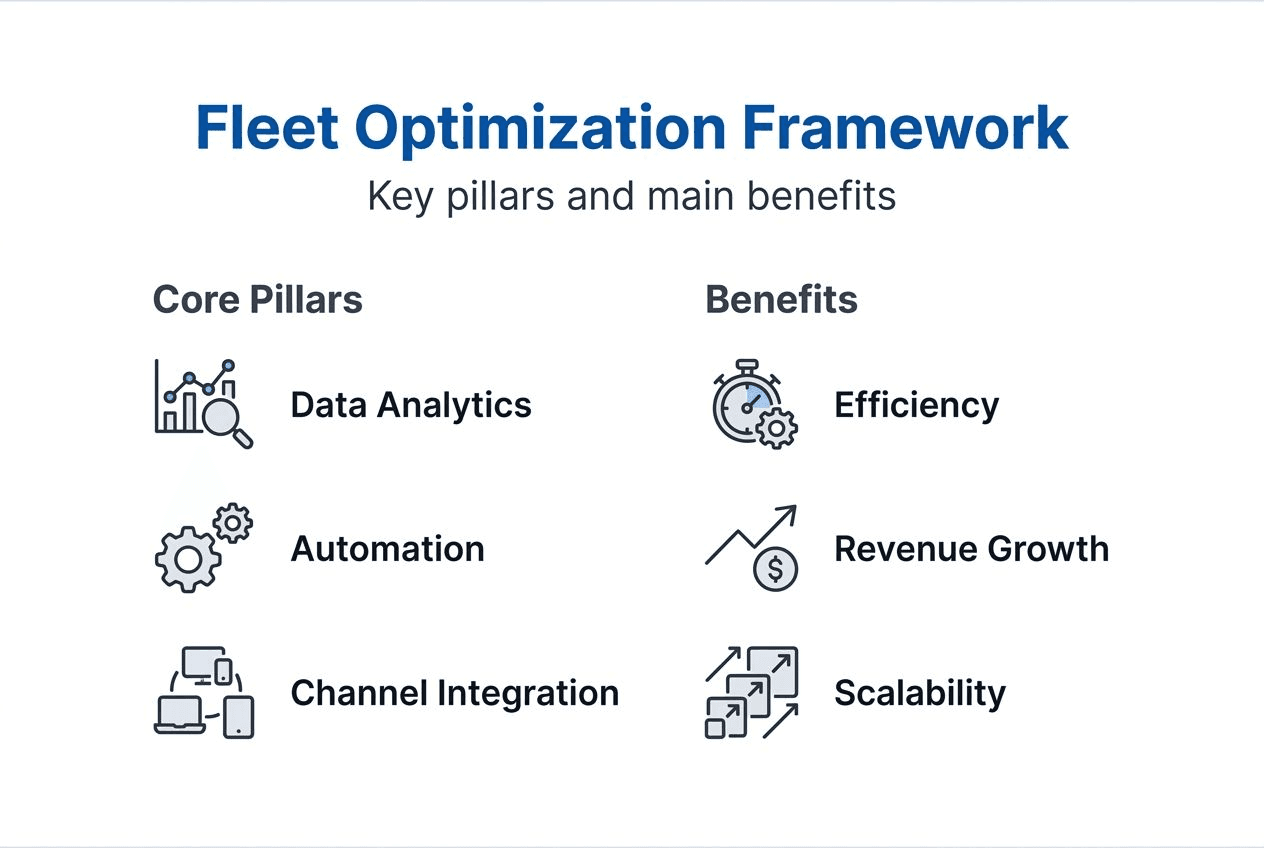
Consider your current operation through this framework. Which pillar represents your biggest gap? Where would investment deliver the highest return? Most operators find that addressing their weakest pillar first creates the foundation for broader optimization.
Exploring fleet management step by step approaches helps you sequence improvements logically. You can also review fleet management alternatives to understand different platform capabilities and find the best fit.
Pro Tip: Focus your initial implementation on the pillars that address your most pressing operational challenges. If manual booking creates bottlenecks, start with automation. If revenue is flat, prioritize dynamic pricing. Targeted improvements build momentum for broader optimization.
Practical applications and decision criteria for transportation operators
Moving from concept to implementation requires a structured approach and clear decision criteria. Canadian charter and private transportation operators can follow these practical steps to adopt fleet optimization effectively.
Implementation roadmap:
Assess your current manual processes to identify the highest-impact automation opportunities
Implement automated booking and instant quote systems as your operational foundation
Deploy dynamic pricing algorithms calibrated to your market and demand patterns
Integrate with external sales channels to expand reach and increase booking volume
Monitor performance metrics and refine parameters based on real-world results
Decision factors when evaluating fleet optimization solutions:
Scalability to support growth without requiring platform replacement
Integration capabilities with your existing systems and external channel partners
Dynamic pricing features that adapt to your specific market conditions
Security standards including PCI compliance for credit card processing
User interface design that your team can adopt quickly without extensive training
Different operators have different priorities. A small charter operation might prioritize ease of use and quick implementation. A larger fleet might emphasize advanced analytics and multi-channel integration. Understanding your specific needs helps you evaluate solutions objectively.
Review strategies to maximize fleet efficiency for bus charters, which apply equally to other vehicle types. The principles of automation, pricing optimization, and connectivity scale across operation sizes. Learning from competitive fleet management in Canada for 2026 shows how integrated approaches deliver 50% faster bookings.
Pro Tip: Start small with core automation features and expand as you realize benefits. Trying to implement everything simultaneously overwhelms your team and delays value realization. Build confidence with initial wins, then scale to more advanced capabilities.
Streamline your fleet operations with GridOps
GridOps delivers the complete fleet optimization platform Canadian charter and private transportation operators need to compete effectively in 2026. Our system combines automated booking and dispatch, dynamic pricing, real-time connectivity, and multi-channel integration in one comprehensive solution.

Designed specifically for Canadian operators, GridOps eliminates manual spreadsheets and phone-based processes. You get instant automated quotes, synchronized availability across all sales channels, and intelligent pricing that responds to market demand. The platform reduces operational errors by 40%, cuts administrative workload by 30%, and helps operators increase revenue by 15-25% through optimized pricing and expanded channel reach. Whether you manage five vehicles or fifty, GridOps scales with your operation while maintaining enterprise-grade security and PCI-compliant payment processing. Explore GridOps pricing and features to find the plan that fits your fleet’s needs and growth ambitions.
Frequently asked questions about fleet optimization
What does fleet optimization mean for charter and private transportation operators?
Fleet optimization integrates data analytics, automation, dynamic pricing, and channel connectivity to maximize vehicle utilization and revenue. It goes far beyond route planning to include automated booking systems, demand-based pricing, real-time dispatch, and integration with hotels, resellers, and tour operators.
How does dynamic pricing differ from traditional fixed pricing models?
Dynamic pricing automatically adjusts fares based on real-time demand, vehicle availability, time of day, and market conditions. Traditional fixed pricing uses the same rates regardless of demand, leaving revenue on the table during peak periods and reducing competitiveness during slow times. Dynamic pricing captures premium revenue when demand is high and attracts price-sensitive customers during off-peak periods.
What are the benefits of integrating with external sales channels?
Channel integration expands your market reach by making your fleet available through hotel booking systems, tour operator platforms, corporate travel tools, and reseller networks. This increases booking volume by up to 30% while automating availability synchronization and preventing double bookings. You reach customers who would never find you through direct channels alone.
What technology and skills are needed to adopt fleet optimization?
You need a comprehensive fleet management platform that supports automation, dynamic pricing, and channel integration. Technical implementation is typically handled by the platform provider. Your team needs basic computer skills to use the system interface and willingness to shift from manual processes to automated workflows. Most operators adapt quickly with minimal training.
How can I measure success after implementing fleet optimization?
Track key metrics including booking volume growth, revenue per vehicle, operational error rates, administrative time spent on manual tasks, customer wait times, and channel booking percentages. Compare these metrics before and after implementation. Most operators see measurable improvements within 60-90 days, with 15-30% revenue increases and 30-40% reductions in administrative workload being common outcomes.
Recommended