Discover how booking automation cuts admin tasks 40%, boosts charter revenue 15%, and increases customer satisfaction 25% for Canadian operators.
Automate bookings: boost efficiency and revenue for charters
Charter operators waste 40% of admin time on manual bookings. Automation slashes errors, expands revenue channels, and delivers instant customer confirmations. Canadian operators adopting real-time reservation for charter operators transform operations, cut costs, and outpace competitors still relying on phones and spreadsheets.
Table of Contents
Introduction To Booking Automation In Charter Transport
Efficiency Gains From Automation
Revenue Maximization Through Automation
Customer Experience Advantages
Integration Benefits With Dispatch And Fleet Management
Common Misconceptions About Automation
Implementation Considerations For Canadian Operators
Conclusion And Next Steps
Explore Booking Automation Solutions With GridOps
Key takeaways
Point | Details |
|---|---|
Automation slashes manual tasks | Reduces manual tasks by 40% and cuts booking errors by 30%. |
Dynamic pricing boosts revenue | Increases revenue by 15% through intelligent pricing and 20% more bookings via reseller channels. |
Instant booking improves satisfaction | Boosts customer satisfaction 25% with real-time availability and confirmations. |
Integration optimizes fleet use | Reduces vehicle idle time by 12% when booking syncs with dispatch systems. |
Myths hold operators back | Automation is affordable, achieves ROI within 12 months, and enhances rather than replaces human roles. |
Introduction to booking automation in charter transport
Booking automation replaces manual phone calls, emails, and spreadsheets with instant digital systems that handle quotes, reservations, and payments. For Canadian charter and shuttle operators, this technology eliminates the chaos of juggling multiple customer inquiries, tracking vehicle availability on paper, and manually calculating pricing for each trip.
Traditional booking methods create bottlenecks. Staff spend hours answering repetitive questions about rates and availability. Errors creep in when copying details between systems. Static pricing leaves money on the table during high demand periods. Customers expect immediate responses, yet manual processes force them to wait hours or days for confirmations.
Automation solves these pain points. Systems instantly check fleet availability, calculate accurate quotes based on distance and vehicle type, and process reservations 24/7 without human intervention. Customers receive confirmations within seconds. Your team focuses on complex requests and relationship building instead of data entry.
Canadian operators face unique challenges: seasonal demand spikes for events and tourism, compliance with provincial regulations, and fierce competition from app-based services. Automation levels the playing field by delivering the speed and convenience customers expect while maintaining profitability.
Key automation benefits:
Instant quote generation based on route, vehicle type, and current demand
Real-time fleet availability visible to customers and staff
Automated payment processing with secure credit card handling
Integration with dispatch systems for seamless trip coordination
Analytics dashboards tracking booking patterns and revenue trends
Efficiency gains from automation
Automation transforms how charter operators manage daily workflows. Manual booking processes require staff to answer phones, check spreadsheets, calculate quotes, send confirmation emails, and update calendars. Each step introduces delays and potential for human error. Automation handles these tasks instantly, allowing your team to focus on service quality and customer relationships.
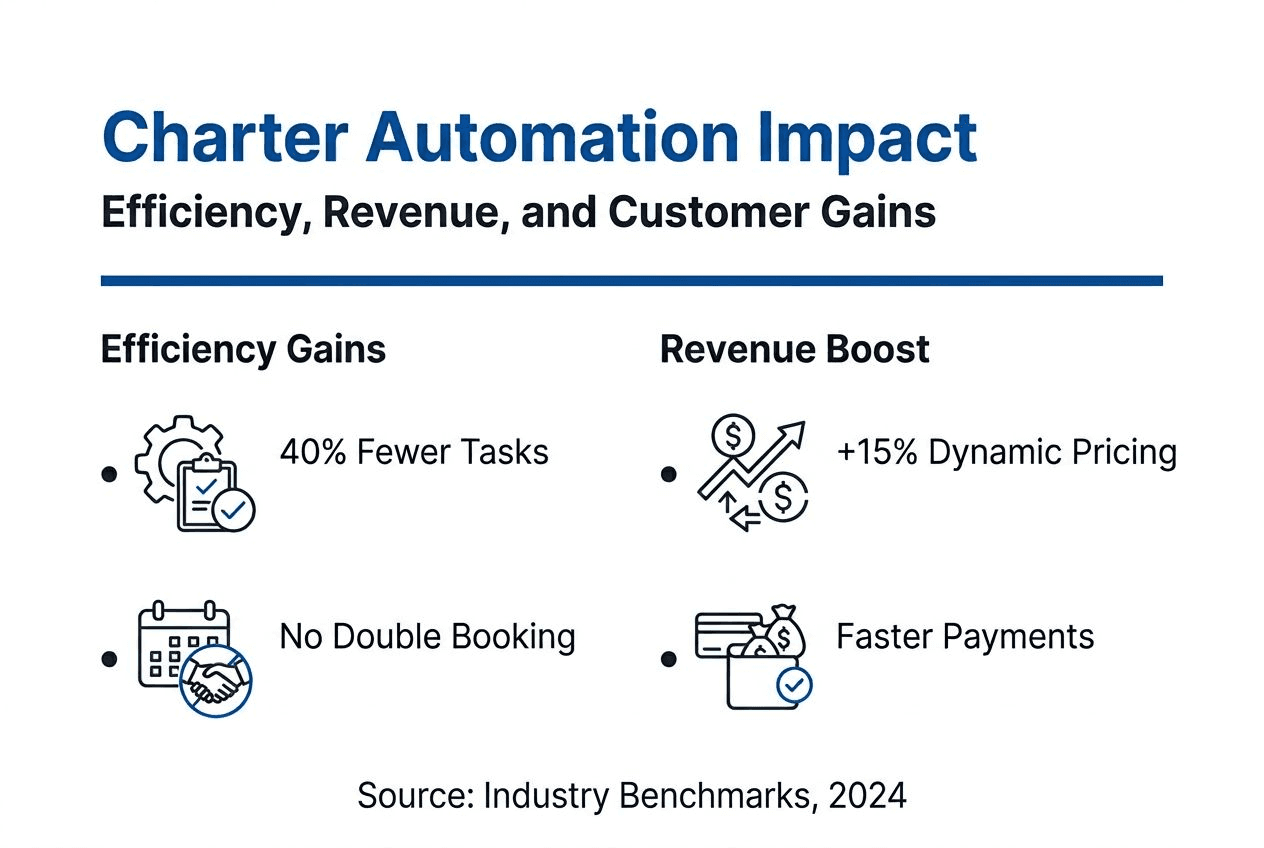
Time savings add up quickly. Automation reduces manual tasks by 40%, freeing staff to handle more bookings without increasing headcount. Booking-to-service time drops by 35%, meaning faster revenue conversion. Billing errors decrease by 30%, eliminating costly corrections and customer disputes.

Scheduling conflicts disappear when systems maintain a single source of truth for vehicle availability. Double bookings vanish because the platform updates in real time as reservations come in. Your dispatch team sees accurate schedules without cross-referencing multiple sources. This precision prevents last-minute scrambles to find replacement vehicles or refund frustrated customers.
Staff productivity soars when repetitive tasks get automated. Instead of spending 20 minutes quoting a single trip, team members handle exceptions, upsell premium services, and build relationships with corporate clients. The mental load of remembering which vehicles are available on specific dates evaporates.
Operators using real-time booking for limo operators report smoother operations and fewer stressed employees. Systems work overnight, processing bookings while you sleep. Morning starts with confirmed reservations, not a pile of voicemails to return.
Pro Tip: Train your entire team on the automation platform during the first month of implementation. Early familiarity ensures everyone leverages features like bulk scheduling and customer history lookups, maximizing efficiency gains from day one.
Revenue maximization through automation
Automation unlocks revenue opportunities impossible with manual systems. Dynamic pricing adjusts rates based on demand, vehicle availability, and seasonal patterns. Instead of charging flat rates year-round, you capture premium pricing during peak seasons and fill off-peak capacity with competitive rates.
Dynamic pricing boosts revenue by 15% by optimizing every quote. Algorithms analyze booking history, competitor rates, and local events to suggest optimal pricing. You maintain control over pricing rules while the system handles calculations instantly for each inquiry.
Reseller connectivity expands your sales channels beyond direct bookings. Integration with hotels, tour operators, and corporate travel platforms generates 20% more bookings through reseller channels. These partnerships fill your calendar with consistent business while reducing customer acquisition costs.
Payment automation accelerates cash flow. Integrated credit card processing collects deposits or full payments at booking time, reducing late payments by 25%. Automated invoicing sends reminders, tracks outstanding balances, and reconciles accounts without manual spreadsheet work. You know your exact financial position in real time.
Feature | Manual Booking | Automated Booking |
|---|---|---|
Pricing strategy | Static, updated quarterly | Dynamic, adjusts per booking |
Sales channels | Direct phone/email only | Direct + reseller networks |
Payment collection | Invoice after service | Instant card processing |
Revenue visibility | Monthly manual reports | Real-time dashboards |
Quote turnaround | Hours to days | Seconds |
Revenue optimization extends beyond pricing. Analytics identify your most profitable routes, vehicles, and customer segments. You spot trends like increased corporate shuttle demand on Tuesdays or wedding season spikes in May. This intelligence guides fleet expansion, marketing spend, and operational planning.
Pro Tip: Review your pricing algorithms monthly, especially after major local events or seasonal shifts. Small tweaks based on actual booking data ensure you capture maximum revenue without pricing yourself out of the market.
Customer experience advantages
Modern customers expect instant gratification. When someone searches for charter services online, they want immediate answers about availability and pricing. Manual systems force prospects to fill out request forms or leave voicemails, then wait hours for responses. Many book with faster competitors before you even reply.
Automation delivers instant booking experiences. Customers see real-time vehicle availability, receive accurate quotes immediately, and confirm reservations without phone calls. Automated reservations increase customer satisfaction by 25% by eliminating wait times and uncertainty.
Booking wait times drop from hours to seconds. A customer planning a corporate event can compare vehicle options, select preferred amenities, and complete payment in under five minutes. Instant confirmation emails include trip details, driver information, and digital receipts. This professional, seamless experience builds trust and encourages repeat business.
Real-time availability prevents disappointing conversations where you must tell interested customers all vehicles are booked. They see open slots instantly and choose alternatives if their first choice is unavailable. Transparency builds confidence in your service and reduces abandoned bookings.
Better customer experiences drive loyalty and referrals. Satisfied customers become advocates who recommend your service to colleagues and friends. Online reviews highlight your professionalism and ease of booking. You build a reputation for reliability that attracts premium corporate clients.
Key customer benefits:
24/7 booking access without calling during business hours
Instant quote accuracy eliminating estimate surprises
Digital trip confirmations reducing pre-service anxiety
Self-service modifications for minor changes like pickup times
Automated reminders sent before trip dates
Integration benefits with dispatch and fleet management
Booking automation reaches peak effectiveness when integrated with dispatch and fleet management systems. Standalone booking platforms create information silos, forcing staff to manually transfer reservation details into dispatch software. Integration eliminates double entry, reduces errors, and provides unified operational visibility.
Integrated booking and dispatch systems reduce vehicle idle time by 12% by optimizing vehicle assignments. The system knows which buses are available, where they’re located, and their maintenance schedules. Smart routing algorithms minimize deadhead miles between jobs, cutting fuel costs and increasing daily trip capacity.
Real-time tracking enhances coordination between booking and field operations. Dispatch sees confirmed reservations the moment customers book, with all trip details automatically populated. Drivers receive digital trip sheets on mobile devices, eliminating paper shuffling and communication gaps. GPS tracking updates estimated arrival times, allowing proactive customer notifications about delays.
Metric | Before Integration | After Integration | Improvement |
|---|---|---|---|
Vehicle idle time | 18% average | 6% average | 67% reduction |
Daily trips per vehicle | 3.2 average | 4.1 average | 28% increase |
Dispatch errors | 8% of bookings | 2% of bookings | 75% reduction |
Fuel efficiency | 6.2 mpg | 7.1 mpg | 15% improvement |
Fleet utilization improves when booking data informs maintenance scheduling. Systems flag vehicles approaching service intervals and automatically block availability during scheduled maintenance. You never accidentally book a vehicle that’s in the shop. Predictive analytics suggest optimal fleet size based on seasonal demand patterns.
Operational cost savings compound over time. Reduced idle time means fewer vehicles needed to handle the same booking volume. Better routing cuts fuel expenses. Fewer errors reduce customer service time spent fixing mistakes. Scalable fleet operations become achievable without proportional cost increases.
Integration benefits extend to financial systems. Automated reservation tracking feeds revenue data directly into accounting software, simplifying reconciliation and tax reporting. You gain complete operational transparency from booking through payment collection.
Common misconceptions about automation
Many charter operators hesitate to adopt automation due to persistent myths that don’t reflect modern realities. These misconceptions delay competitive advantages and cost efficiency gains.
Myth: Automation is too expensive for small operators. Truth is, cloud-based SaaS platforms start at affordable monthly subscriptions with no massive upfront investment. ROI typically arrives within 12 months through reduced labor costs, increased booking volume, and optimized pricing. Small operators gain enterprise-grade tools previously available only to large fleets.
Myth: Automation systems are too complex to implement. Modern platforms prioritize user-friendly interfaces designed for non-technical users. Implementation takes weeks, not months. Vendors provide training, onboarding support, and ongoing customer success resources. Most operators run live within 30 days of signing up.
Myth: Automation replaces human jobs. Automation eliminates repetitive data entry, not people. Staff transition from answering the same pricing questions repeatedly to handling complex customer needs, building corporate relationships, and improving service quality. Teams become more productive and engaged when freed from mundane tasks.
Myth: Customers prefer speaking with humans. While some customers want personal interaction for complex trips, most prefer instant self-service for straightforward bookings. Automation serves both: simple reservations happen instantly online, while staff focus on high-touch customers requiring customization. Satisfaction increases across all customer segments.
Myth: Our current system works fine. Manual processes seem adequate until you experience automation. Hidden costs include missed bookings outside business hours, revenue lost to pricing errors, and customer churn from slow response times. Competitors adopting automation capture market share while you remain unaware of opportunities slipping away.
Key facts:
SaaS platforms typically cost $200-500 monthly, far less than one employee
Training requires days, not months of disruption
Staff satisfaction often increases with automation adoption
70% of customers prefer self-service booking for simple trips
Manual operations carry hidden costs totaling 15-25% of revenue
Understanding these realities helps operators make informed decisions based on actual costs, benefits, and implementation requirements rather than unfounded fears.
Implementation considerations for Canadian operators
Successful automation requires planning tailored to Canadian operational realities. Provincial regulations, bilingual requirements, and seasonal demand patterns influence platform selection and rollout strategies.
Choose platforms complying with Canadian privacy laws and payment processing standards. Systems must handle PST, GST, and HST appropriately across different provinces. Look for vendors with Canadian data residency options to ensure customer information stays within national borders.
Scalability matters for seasonal businesses. Your system should handle summer tourism peaks without performance degradation, then scale costs down during quiet winters. Cloud-based platforms offer this flexibility better than on-premise installations.
Implementation roadmap:
Audit current booking processes to identify pain points and automation priorities
Define must-have features like dynamic pricing, reseller integration, and dispatch connectivity
Evaluate platforms offering free trials or demos to test functionality with real scenarios
Create a migration plan for transferring existing customer data and reservation history
Train staff in phases, starting with super-users who can mentor colleagues
Launch with a soft rollout to test workflows before full customer-facing deployment
Gather feedback from staff and customers during the first 90 days
Optimize settings based on actual usage patterns and performance data
Change management determines success as much as technology selection. Involve your team early, explaining how automation makes their jobs easier rather than threatening job security. Celebrate early wins like the first automated booking or a week without scheduling conflicts.
Staff training should cover both technical operation and strategic thinking. Teach employees to leverage analytics for upselling, use customer history for personalization, and interpret demand patterns for operational planning. Automation provides tools, but human judgment drives business outcomes.
Pro Tip: Start with a pilot program serving one customer segment or vehicle type before full deployment. This approach identifies configuration issues, validates ROI assumptions, and builds internal confidence with manageable risk.
Customer communication smooths the transition. Announce new booking options through email, social media, and your website. Emphasize benefits like 24/7 availability and instant confirmations. Keep phone booking available initially for customers who prefer it, gradually shifting traffic as comfort grows.
Security and reliability are non-negotiable. Verify platforms use encrypted payment processing, maintain SOC 2 compliance, and offer uptime guarantees. Ask about backup systems, disaster recovery plans, and data export options. Your booking system becomes business-critical infrastructure.
Conclusion and next steps
Booking automation delivers measurable improvements across every charter operation metric. You reduce administrative burden by 40%, increase revenue through dynamic pricing and expanded channels, and boost customer satisfaction by 25% with instant service. Integration with dispatch and fleet management optimizes vehicle utilization while cutting idle time and operational costs.
Start by assessing your current manual workflows. Calculate time spent on booking tasks, track lost opportunities from delayed responses, and measure customer complaints about booking friction. These baseline metrics demonstrate automation ROI and guide platform selection.
Canadian charter operators can’t afford to ignore automation while competitors capture market share through superior customer experiences and operational efficiency. The technology has matured beyond early-adopter risk into proven solutions with clear payback periods.
Explore options tailored to transportation businesses rather than generic booking systems. Platforms like GridOps understand charter-specific needs including vehicle variety, complex pricing rules, and integration with existing fleet management tools. The right solution transforms your booking process from operational headache to competitive advantage.
Explore booking automation solutions with GridOps
GridOps specializes in booking automation for Canadian charter, limo, and shuttle operators seeking efficiency and revenue growth. The platform eliminates manual quoting, enables dynamic pricing, and connects you with major resellers to expand your sales channels.

Built in Alberta, GridOps understands Canadian operational realities including provincial regulations, seasonal demand, and competitive pressures. The system integrates real-time dispatch, reservation tracking, financial analytics, and secure payment processing into one unified platform. You gain enterprise-grade automation without enterprise-level complexity or cost.
Your customer success manager guides implementation, training, and optimization. Support extends beyond technical setup to strategic advice on pricing rules, reseller partnerships, and operational workflows. GridOps treats your success as their success.
Visit the GridOps pricing page to explore subscription options matching your fleet size and feature requirements. Schedule a demo to see how automation transforms your booking process from frustration to competitive advantage.
Pro Tip: Request a personalized demo showing GridOps configured for your specific vehicle types, routes, and pricing structure. Seeing your actual scenarios automated makes the value immediately clear and helps identify configuration questions before launch.
FAQ
Is booking automation expensive for small Canadian charter operators?
Cloud-based booking automation starts at $200-500 monthly, comparable to basic software subscriptions. Most small operators achieve ROI within 12 months through increased bookings, reduced labor costs, and optimized pricing. SaaS models eliminate large upfront investments in servers or custom development.
How does booking automation improve customer satisfaction?
Automation delivers instant quotes and confirmations, eliminating frustrating wait times for responses. Customers access real-time availability 24/7 without calling during business hours. Satisfaction scores increase 25% when customers control their booking experience and receive immediate service.
Can booking automation integrate with existing dispatch systems?
Modern platforms integrate seamlessly with dispatch and fleet management systems through APIs and data exports. Integration reduces vehicle idle time by 12% by synchronizing reservations with dispatch assignments. This connectivity eliminates double entry and provides unified operational visibility across booking, dispatch, and financial systems.
What should Canadian operators consider when implementing booking automation?
Prioritize platforms complying with Canadian privacy laws and provincial tax requirements. Ensure systems handle bilingual content if serving Quebec or other French-speaking markets. Choose scalable solutions accommodating seasonal demand fluctuations. Train staff thoroughly on both technical operation and strategic features to maximize adoption and ROI.
Recommended