Discover how real-time reservation systems automate bookings, boost revenue by 25%, and improve fleet efficiency for Canadian charter operators in 2026.
What is real-time reservation for charter operators?
Charter operators who rely on phone calls and spreadsheets for bookings face a hidden cost that few realize. Manual booking processes can lead to up to 30% loss in potential bookings due to delays and errors. Real-time reservation systems eliminate these inefficiencies by automating booking confirmations, integrating dynamic pricing, and connecting directly with fleet dispatch. This guide explains what real-time reservation means for Canadian charter and private transportation operators and why it matters for your bottom line in 2026.
Table of Contents
Introduction To Real-Time Reservation Systems
How Real-Time Reservation Automates Booking And Dispatch
Common Misconceptions About Real-Time Reservation Systems
Comparing Manual Vs Automated Reservation Processes
Practical Benefits For Canadian Charter And Private Transportation Operators
Platform Features Supporting Connectivity And Compliance In Canada
Choosing And Implementing A Real-Time Reservation System
Streamline Your Operations With GridOps Real-Time Reservation
Key takeaways
Point | Details |
|---|---|
Real-time automation speeds confirmations | Instant booking approvals replace slow phone and email exchanges, capturing more customers. |
Dynamic pricing boosts revenue | Adjusting rates based on demand can increase revenue by up to 25%. |
Integrated dispatch improves efficiency | Real-time fleet data optimizes vehicle assignments and reduces idle time. |
Manual errors decrease significantly | Automation frees staff from repetitive data entry, cutting mistakes by 40%. |
Canadian compliance is essential | Systems must meet local privacy, tax, and payment processing requirements. |
Introduction to real-time reservation systems
Real-time reservation in charter and private transport means customers receive immediate booking confirmations without waiting for manual approval. Unlike traditional methods where operators juggle phone calls, spreadsheets, and email chains, real-time reservation integrates instant booking confirmations with dynamic pricing and fleet dispatch. The system checks availability, calculates pricing, and confirms the booking in seconds.
This automation replaces fragmented manual processes that create delays and errors. When a customer requests a charter, the system instantly queries vehicle availability, applies current pricing rules, and generates a confirmation. No phone tag. No missed opportunities.
Several core technologies enable this seamless workflow:
Booking automation engines process reservation requests without human intervention, checking fleet calendars and applying business rules instantly
Dynamic pricing modules adjust rates based on demand, vehicle type, distance, and seasonal factors to maximize revenue per trip
Real-time dispatch integration connects reservations directly to fleet management, automatically assigning vehicles and drivers as bookings confirm
Payment processing systems handle credit card authorizations and deposits immediately, securing revenue and reducing no-shows
Customer portals provide transparent pricing and instant quotes, improving the booking experience and conversion rates
These components work together to create a digital workflow that eliminates the bottlenecks of manual reservation handling. The result is faster bookings, fewer errors, and better resource utilization. For operators used to spreadsheets and phone-based systems, this represents a fundamental shift in how reservations flow through your business. The automated quoting and reservation integration transforms customer interactions from reactive to proactive.
How real-time reservation automates booking and dispatch
Understanding the automation process helps you see exactly how real-time systems improve operations. Here’s the step-by-step workflow:
Customer initiates request: A potential client visits your website or booking portal and enters trip details like date, time, passenger count, and route.
System checks availability: The platform instantly queries your fleet calendar, identifying available vehicles that match the request parameters.
Dynamic pricing calculates rate: Pricing algorithms factor in distance, vehicle type, demand levels, and your configured margins to generate an optimized quote.
Instant quote delivery: The customer sees the price immediately, with no waiting for callback or email response.
Booking confirmation: Upon customer acceptance, the system confirms the reservation, processes payment authorization, and updates all connected calendars.
Dispatch assignment: Real-time integration assigns the booking to an available vehicle and driver, sending notifications and trip details automatically.
Dynamic pricing integration with real-time booking can boost operator revenue by up to 25% by capturing peak demand opportunities and filling off-peak capacity more effectively. Instead of static rate cards, your pricing responds to market conditions in real time.
Real-time dispatch uses live fleet data to assign vehicles efficiently. The system considers vehicle location, maintenance schedules, driver availability, and routing logistics. This reduces empty miles, improves turnaround times, and increases daily trip capacity.

Operational workflows shift dramatically. Dispatchers spend less time on manual data entry and phone coordination. Staff focus on exception handling, customer service, and strategic planning instead of routine booking tasks. Scalable fleet operations become possible as automation handles volume increases without proportional staffing growth.
Pro Tip: Integrate your reservation and dispatch systems from day one. Operators who connect these platforms early see faster return on investment and avoid the complexity of migrating data between disconnected tools later. Unified systems provide better reservation tracking workflows and clearer visibility into fleet efficiency improvements.
Common misconceptions about real-time reservation systems
Several myths prevent operators from adopting real-time reservation technology. Let’s address the most common misunderstandings.
Myth 1: Systems replace booking staff completely. Reality check: Automation frees up 40% of manual booking labor hours without replacing staff. Your team shifts from repetitive data entry to relationship building, upselling, and handling complex custom requests that require human judgment. Automation handles routine bookings while staff deliver high-value customer interactions.
Myth 2: Real-time reservation is only for large fleets. Small and medium operators achieve measurable gains too. A 10-vehicle fleet sees the same percentage improvements in booking speed, error reduction, and pricing optimization as a 100-vehicle operation. The technology scales to fit your size, and cloud-based platforms eliminate the need for massive upfront infrastructure investment.
Myth 3: Real-time reservation is just an online booking portal. This oversimplifies what modern systems do. True real-time reservation platforms integrate:
Dynamic pricing engines that adjust rates automatically
Dispatch management connecting bookings to vehicle assignments
Financial analytics tracking revenue, costs, and profitability by trip
Customer relationship management storing preferences and booking history
Payment processing securing deposits and final settlements
A simple booking form on your website is not the same as a comprehensive real-time reservation system. The difference lies in backend integration and intelligence.
Understanding these realities helps you evaluate platforms accurately. Real-time reservation supports and enhances your team rather than eliminating it. The technology serves operators of all sizes and delivers far more than basic online booking. Making decisions based on facts instead of fears positions you to capture genuine competitive advantages in 2026.
Comparing manual vs automated reservation processes
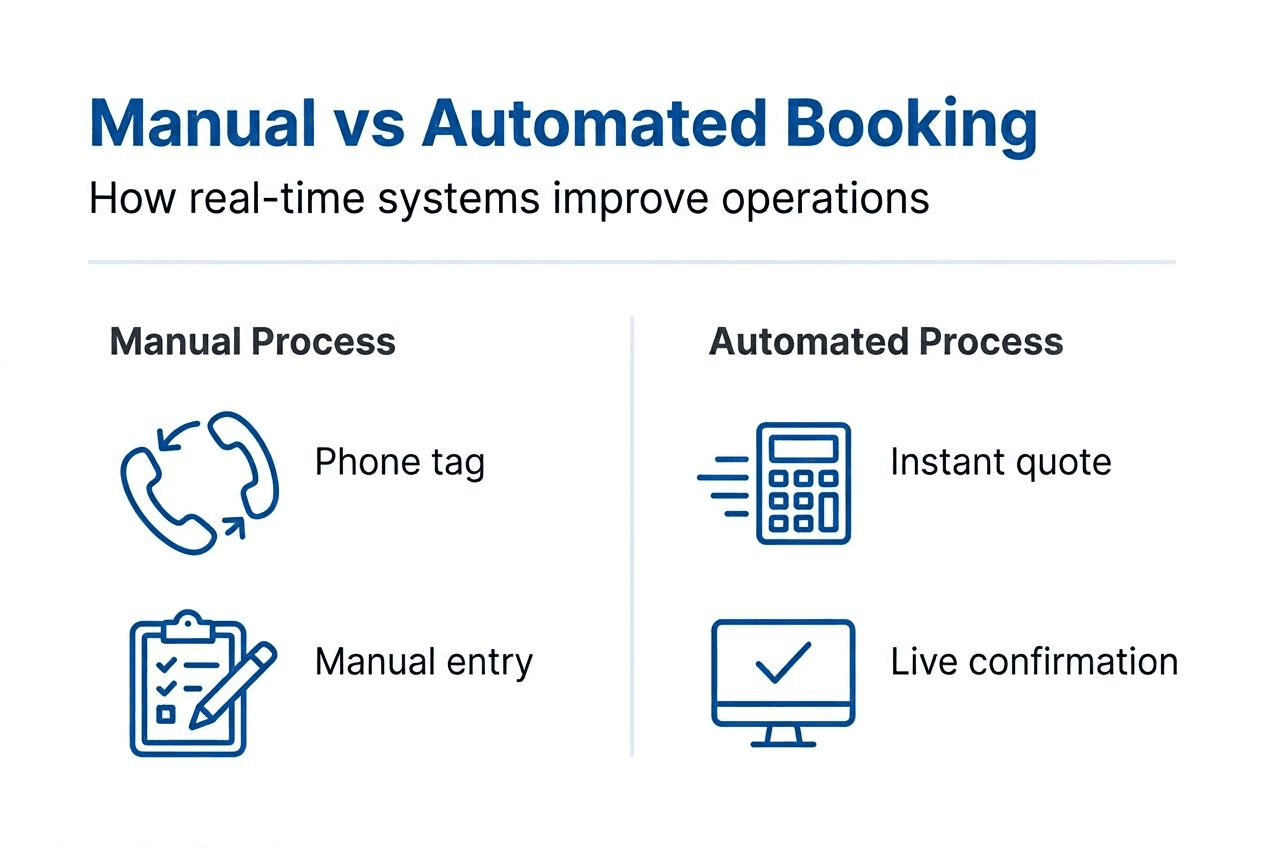
Seeing the operational and financial differences side by side clarifies why automation matters.
Aspect | Manual Process | Automated Process |
|---|---|---|
Booking speed | Hours to days for quote and confirmation | Seconds for instant quote and booking |
Pricing accuracy | Static rates, manual calculations prone to errors | Dynamic pricing optimized for demand and margins |
Staff time per booking | 15-30 minutes of phone and email coordination | Under 2 minutes for exception handling only |
Error rate | High due to manual data entry and transcription | Minimal, automated data validation catches issues |
After-hours bookings | Lost opportunities when office closed | 24/7 availability captures all requests |
Dispatch integration | Separate manual coordination steps | Automatic vehicle assignment on confirmation |
Payment processing | Manual credit card entry, delayed settlements | Instant authorization, reduced payment defaults |
Revenue optimization | Limited ability to adjust pricing dynamically | Real-time rate adjustments maximize income |
Manual reservations suffer higher booking errors and revenue losses than automated systems, creating operational friction that compounds as your business grows. Key efficiency gains include:
Booking conversion rates improve by 15-25% when customers receive instant quotes instead of waiting for callbacks
Data entry errors drop by 40-60% as systems validate information automatically and eliminate manual transcription
After-hours revenue increases by 10-20% by capturing bookings when traditional offices are closed
Staff productivity rises as automation handles routine tasks, freeing employees for complex customer needs and business development
Consider a typical scenario. Manual process: customer calls, leaves voicemail, operator calls back hours later, checks availability on spreadsheet, calculates price manually, calls customer again, negotiates terms, takes credit card over phone, enters booking into multiple systems. Total time: 30-45 minutes spread over multiple interactions.
Automated process: customer visits website, enters trip details, sees instant quote, confirms booking, receives confirmation email with trip details and payment receipt. Total operator involvement: zero for standard bookings, under 5 minutes for custom requests. The benefits of real-time booking become clear when you calculate time savings multiplied across hundreds of bookings annually.
Practical benefits for Canadian charter and private transportation operators
Real-world results demonstrate measurable improvements across operational, financial, and customer service dimensions. Operators report up to 20% increase in booking volume and 15-20% improved fleet utilization using real-time systems with dynamic pricing. Here’s what this means practically:
Customer experience and conversion: Instant automated quotes satisfy the modern expectation for immediate information. Payment processing at booking time reduces no-shows and secures revenue upfront. Transparent pricing builds trust and reduces negotiation friction.
Operational efficiency: Reduced data entry errors save time correcting mistakes and prevent service failures. Manual workload decreases as automation handles routine bookings, allowing staff to focus on complex requests and customer relationships. Integrated dispatch eliminates coordination delays between booking and vehicle assignment.
Revenue growth: Dynamic pricing captures premium rates during high-demand periods while filling off-peak capacity with optimized discounts. Multichannel connectivity expands your reach to resellers, hotels, and tour providers without additional sales staff. Better pricing intelligence improves margin management across all trip types.
Fleet utilization: Real-time dispatch data improves vehicle assignments based on location and availability. Lower idle time increases trips per vehicle per day. Better route planning reduces fuel costs and maintenance wear.
These improvements compound over time. A 15% increase in fleet utilization might seem modest initially, but multiplied across your entire fleet for a full year, it represents significant additional revenue without acquiring more vehicles. The competitive fleet management statistics show operators who adopt early gain market share from competitors still using manual methods.
Pro Tip: Monitor key metrics continuously during the first 90 days after implementation. Track booking conversion rates, average quote-to-confirmation time, error rates, and revenue per vehicle. These baseline measurements help you optimize system configuration and demonstrate return on investment to stakeholders.
Platform features supporting connectivity and compliance in Canada
Operating successfully in Canada requires specific technical and regulatory capabilities. Real-time reservation platforms must include:
Multichannel connectivity: Integration with major resellers, hotel concierge systems, and tour operator platforms expands your distribution without manual coordination. API interfaces allow partners to check availability and book directly into your system.
Canadian payment processing: Integration with Canadian credit card processors, support for CAD currency, and proper handling of GST/HST tax calculations ensure compliant transactions. Secure payment gateways protect customer financial data.
Privacy compliance: Compliance with Canadian privacy, tax, and payment regulations is essential for successful platform adoption. Systems must align with federal and provincial data protection requirements, particularly for storing and processing personal customer information.
Digital trip sheets and authorizations: Electronic documentation reduces paperwork and improves driver communication. Digital credit card authorizations capture customer signatures and payment approvals securely.
Seamless API interfaces: Connection to existing dispatch, accounting, and financial systems prevents data silos. Real-time data synchronization ensures all platforms reflect current booking status and fleet availability.
These features aren’t optional extras. They’re foundational requirements for operating legally and efficiently in the Canadian market. The Canadian compliant reservation system features protect your business from regulatory issues while enabling the connectivity needed to compete effectively.
Platforms built specifically for Canadian operators understand regional nuances like bilingual support requirements, provincial licensing variations, and local payment preferences. Generic international systems often require extensive customization to meet Canadian standards. Choosing a platform designed for your market saves implementation time and reduces ongoing compliance risks.
Choosing and implementing a real-time reservation system
Selecting and deploying the right platform requires systematic evaluation and planning. Use this checklist to guide your decision:
Verify Canadian compliance: Confirm the platform meets federal and provincial privacy laws, supports Canadian payment processing, and handles GST/HST correctly. Ask vendors for compliance documentation.
Assess integration capabilities: Check compatibility with your existing dispatch, accounting, and communication tools. APIs should connect seamlessly without requiring custom development.
Evaluate dynamic pricing features: Ensure the system offers flexible pricing rules based on demand, distance, vehicle type, and seasonal factors. Test the pricing engine with realistic scenarios.
Review user interface: Both customer-facing booking portals and internal management dashboards should be intuitive. Request demo access to evaluate usability.
Confirm scalability: Verify the platform can grow with your fleet size and booking volume without performance degradation or cost spikes.
Analyze total cost: Include licensing fees, implementation costs, training time, and ongoing support. Compare total cost of ownership across vendors.
Check vendor support quality: Canadian-based support teams understand local market conditions and regulations better. Verify support availability during your business hours.
Balancing these criteria involves tradeoffs. More features typically mean higher costs and longer implementation. Start with core requirements and add advanced capabilities as you master the basics.
Implementation follows a proven sequence:
Run a pilot program: Test the system with a subset of your fleet and customer base. Monitor performance closely and gather feedback.
Train staff thoroughly: Invest time teaching your team how to use the platform effectively. Include both booking staff and drivers who interact with dispatch features.
Scale gradually: Expand to your full operation once the pilot proves successful and staff are comfortable with the new workflows.
Monitor and optimize: Track key metrics continuously. Adjust pricing rules, booking workflows, and dispatch assignments based on real performance data.
Pro Tip: Engage vendor support actively during implementation. Ask questions, request training sessions, and use their expertise to configure the system optimally for your specific operation. Vendors who understand Canadian charter operations provide guidance that generic consultants cannot match. The scalable fleet management implementation process benefits significantly from experienced support partners.
Acting now positions you ahead of competitors who delay adoption. The 2026 charter market rewards operators who deliver instant quotes, transparent pricing, and seamless booking experiences. Real-time reservation systems provide these capabilities while reducing your operational costs and workload.
Streamline your operations with GridOps real-time reservation
Ready to eliminate manual booking bottlenecks and boost your revenue? GridOps offers a Canadian-compliant platform specifically designed for charter and private transportation operators. Our system automates booking, integrates dynamic pricing, and connects seamlessly with real-time dispatch management.

Operators using GridOps experience faster bookings, improved fleet utilization, and measurable revenue growth. The platform handles instant quotes, secure payment processing, and multichannel connectivity, allowing you to optimize your fleet operations while your staff focuses on exceptional customer service. See how GridOps delivers 50% faster bookings for Canadian charter operators.
Explore detailed implementation guides, success stories, and feature demonstrations at the GridOps reservation system website. Discover how real-time automation transforms charter operations from reactive to proactive, positioning your business for sustained growth in 2026 and beyond.
Frequently asked questions
What does real-time reservation mean in charter transport?
Real-time reservation means customers receive instant booking confirmations without waiting for manual operator approval. The system automatically checks vehicle availability, calculates dynamic pricing, and confirms the reservation in seconds. This eliminates delays from phone tag and email exchanges that characterize traditional booking methods.
How does dynamic pricing work in these systems?
Dynamic pricing adjusts rates automatically based on factors like demand levels, vehicle availability, trip distance, and seasonal patterns. Algorithms analyze these variables in real time and optimize pricing to maximize revenue during peak periods while filling capacity during slower times. You configure pricing rules that align with your business strategy, and the system applies them consistently.
Are real-time reservation systems suitable for small operators?
Yes, small and medium operators achieve proportional benefits comparable to large fleets. Cloud-based platforms scale to fit your operation size without requiring massive infrastructure investment. A 10-vehicle fleet sees the same percentage improvements in booking speed, error reduction, and revenue optimization as larger operations. The technology adapts to your business rather than requiring you to fit a rigid template.
What integration features should I consider for Canadian compliance?
Essential features include Canadian payment processing with proper GST/HST handling, privacy compliance aligned with federal and provincial data protection laws, bilingual support where required, and connectivity with Canadian reseller networks. Verify the platform supports CAD currency, integrates with Canadian credit card processors, and meets local regulatory standards for storing customer information.
How quickly can I expect operational improvements after implementation?
Most operators see measurable improvements within 30 to 60 days of full implementation. Booking conversion rates and customer satisfaction improve almost immediately as instant quotes replace delayed responses. Staff productivity gains become evident as automation reduces manual workload. Revenue optimization through dynamic pricing builds over 90 to 120 days as the system learns demand patterns and refines pricing strategies.
Recommended